


Harry Chávez doesn’t simply paint the Amazon, he listens to it. Animals, plants, guardians, the flicker of spirits at dusk, the quiet geometry of the riverbanks, all of it has become a language he has learned over years of attentive looking.
A Door Into the Invisible
Harry’s connection to the Andean–Amazonian world began with the objects themselves. “What first moved me,” he recalls, “was encountering pre-Hispanic artworks and the ceremonial pieces used by Amazonian communities. Their beauty and sophistication weren’t just visual, they held codes, memories, entire cosmologies. They opened a door for me I didn’t even know I was searching for.”
An important part of that door came through his encounters with Peruvian shamanic traditions, their rituals, their silence, their plant teachers, and the way knowledge is transmitted through visions rather than words. “Art is a bridge toward other dimensions,” he says. “It gives shape to what we feel but cannot see. It can shift a person’s state of mind, transform a space, summon memory. That is the power it carries.”
Why Myths Matter Today
For Harry, the Amazon is more than a territory: it is a way of imagining the world differently. “We’re living through a profound crisis of imagination,” he explains. “We’ve lost the capacity to create new stories that help us live with purpose and connection. The Amazon still has those stories: ones where humans, animals, and spirits inhabit the same field of reality. My work tries to bring that way of seeing back into the conversation.”
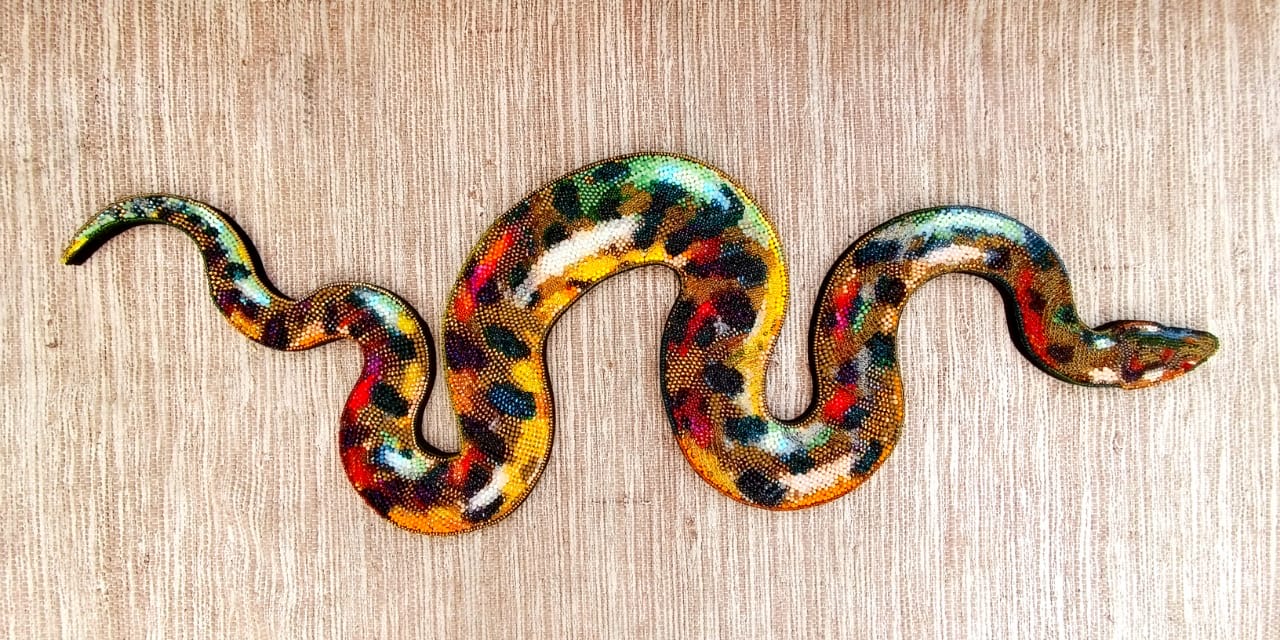
This is where his animals emerge, not as illustrations of biodiversity, but as forces, teachers, and witnesses. The anaconda, the otorongo, the birds, and the river beings appear interconnected, woven into geometric patterns that echo Indigenous maps of the cosmos.
Technique: Ancestral Precision, Contemporary Craft
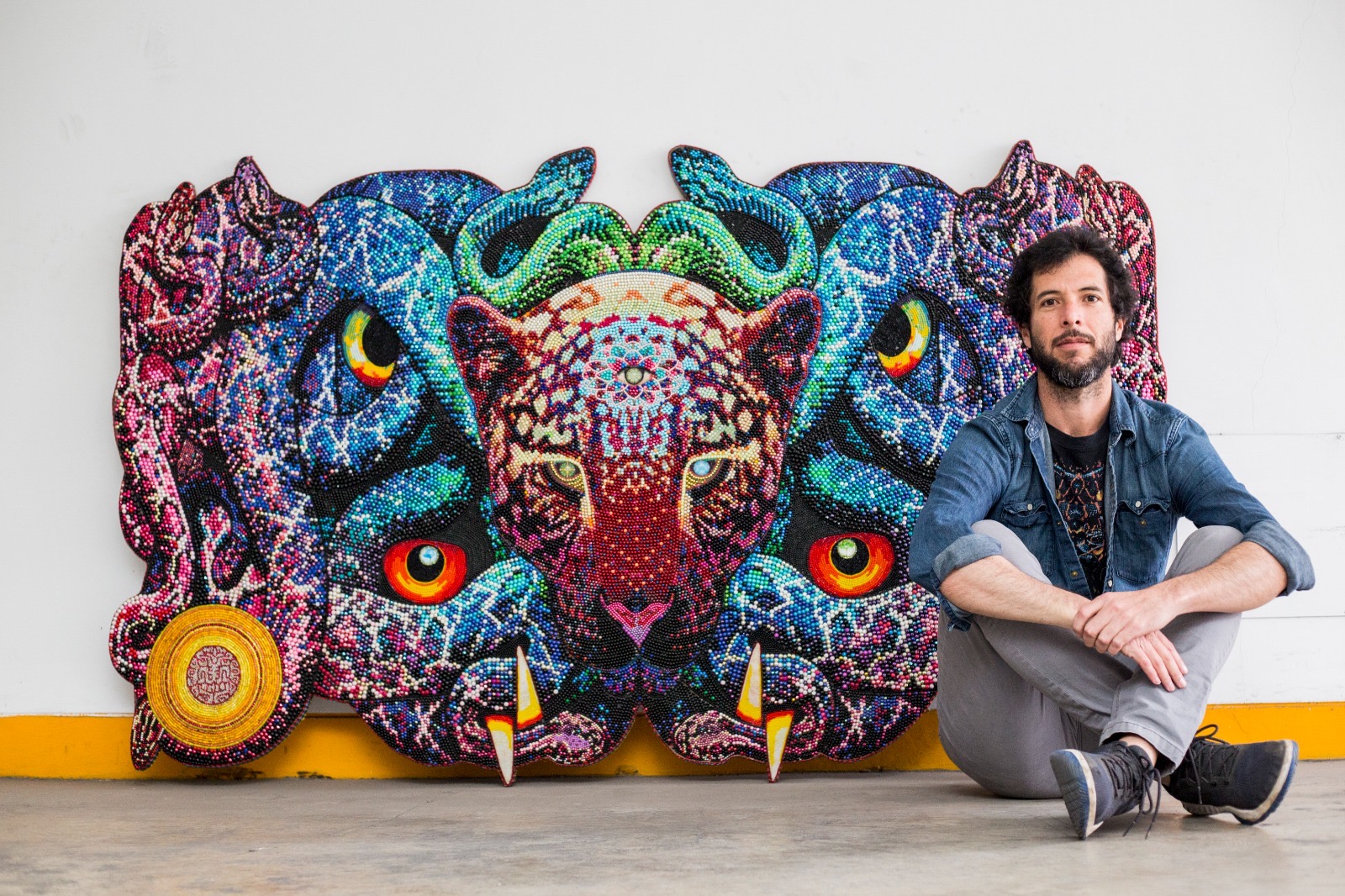
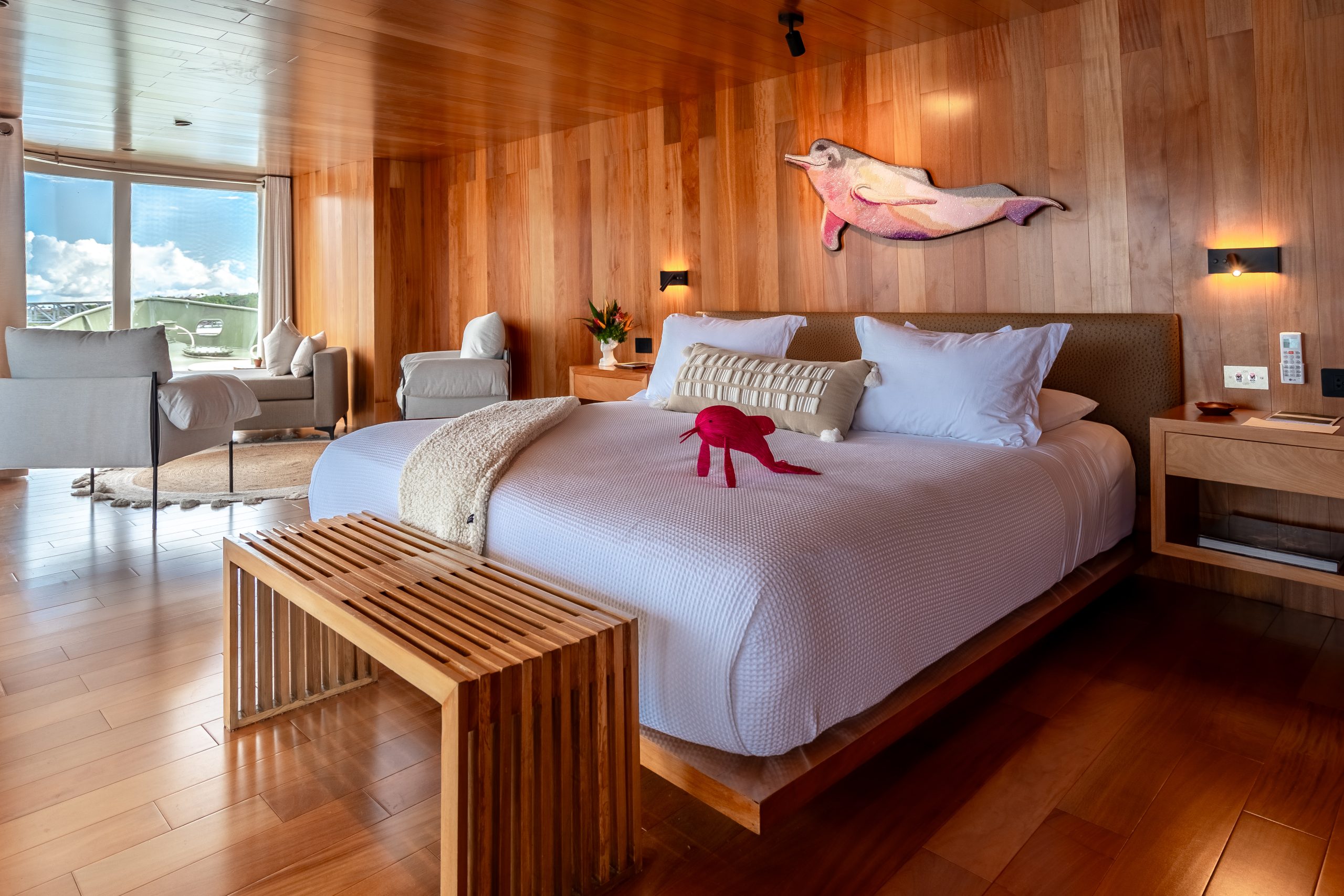
Harry’s visual world is built through a hybrid technique that combines meticulous hand-drawing with modular, mosaic-based beaded construction. Every piece begins with a detailed graphite sketch where animals, patterns, and symbols are placed with ritual-like intention.
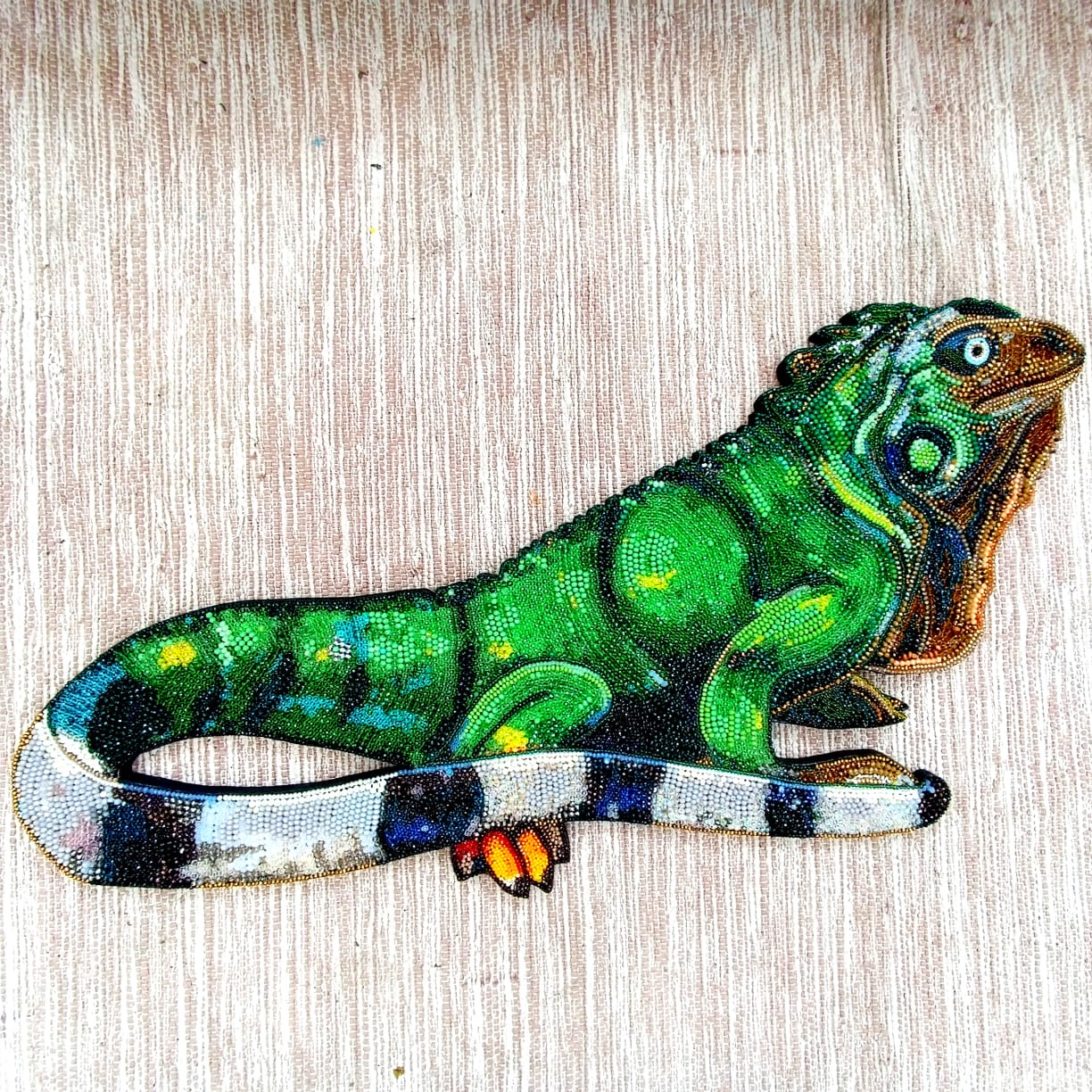
He then translates this drawing into thousands of beads. Each fragment carries its own tone and texture, allowing light to move across the surface like river water. The pieces are assembled by hand in a slow, meditative process that can take weeks.
This technique creates a surface that is almost architectural — textured, dimensional, and vibrating with pattern. The final effect is less “mosaic” in the traditional sense and more a contemporary codex, where each tile becomes a syllable in a larger mythic text.
Harry’s process takes immense patience and it is rooted in both his formal studies and ancestral traditions. It recalls the vibrant surfaces of the Wixarika in Mexico, the geometric kené of the Shipibo in Peru, and the dotted language of Aboriginal Australia. He also embraces collage, layering meaning like sediment.
The Mosaic for Delfin I
This approach culminated in the art pieces he created for Delfin I, a work that has quickly become one of the ship’s quiet icons. Rather than producing a conventional “Amazon theme,” Harry constructed a constellation of beings that act as guardians of the space.
“The animals are not there to decorate a wall,” he says. “They’re part of a larger story — a story about memory, transformation, and the intelligence of nature. They’re protectors. They’re a map.”
The pieces mirror what Delfin stands for: a deep respect for the Amazon and a belief that art can help us see, the spirit of a living, breathing ecosystem.
A Living Mythology
Harry’s Amazon is not imaginary. It is learned, lived, and refined through years of listening to the forest, the river, and the people who carry its traditions. His work reminds us that the Amazon is not just a landscape; it is a teacher, a storyteller, and a keeper of memory.
We are honored to carry his vision aboard Delfin I, where travelers encounter not only the beauty of the river, but the deeper stories that have shaped it for millennia.
Harry Chavez work can be found at Grada Gallery in Bajada de Baños 349, Barranco
https://www.instagram.com/