


The Forbidden Lake
Dimas Paredes and a Cocktail on the Amazon
Aboard Delfín, a painting by Dimas Paredes and a camu camu cocktail invite a closer encounter with the Amazon through art and the senses.
To concentrate, Dimas Paredes looks at the Ucayali River. He has spoken of the pleasure he takes in observing insects and plants, people and clouds. His paintings reward a similar attention, drawing the eye into forests where each leaf seems to have been considered.
Born in Masisea, in Peru’s Ucayali region, Paredes learned about plants from his father, Laurencio, a traditional healer. At 43, he entered the Usko Ayar school in Pucallpa to study with Pablo Amaringo, a leading figure in Amazonian visionary painting. His education in the forest had begun long before his formal training as a painter.
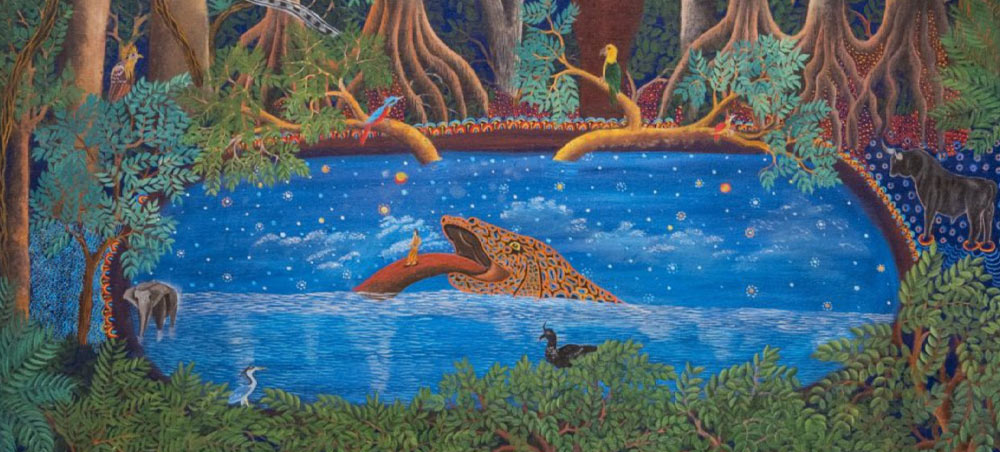
El lago prohibido (The Forbidden Lake), painted in 2020, belongs to this lifetime of learning. Curator Gredna Landolt reads the points of light scattered through Paredes’s forests as the energy of plants and their guardian spirits. Artist and curator Christian Bendayán connects his work to knowledge acquired through rituals with ayahuasca and other plants. Such accounts help us approach the relationships that fill his paintings, where botanical observation and spiritual experience are closely entwined.
Paredes has called the forest “our library and our ecological pharmacy”. His concern about its destruction follows from that understanding. What is at stake includes the knowledge people acquire through years of living with plants, and the possibility of passing it on. His paintings give us time to consider how much a forest can hold.
Such knowledge is finding new audiences in contemporary art. At the 2026 Venice Biennale, Sara Flores represents Peru with paintings grounded in kené, the ancestral visual language of her Shipibo-Konibo community. Her geometric compositions and Paredes’s visionary forests emerge from distinct practices. Together, they suggest the breadth of artistic thinking coming from the region, and the value of getting to know the individual artists behind it.
On the final evening aboard Delfín, there is time to linger with Paredes’s painting, a camu camu cocktail in hand and the river all around.
The drink brings two Peruvian landscapes together. Pisco, distilled from grapes grown in the coastal valleys, meets camu camu, a fruit of the Amazon’s riverbanks and floodplains. Its shrubs can stand in floodwater for months; the small fruits ripen from pink to deep red and are familiar in local juices and ice creams. In the cocktail, fresh camu camu juice supplies a pronounced tartness, while a cordial made from the same fruit rounds it with sweetness. The recipe works with the fruit’s character, balancing its acidity against the spirit.
Chuchuhuasi adds a preparation familiar in the Peruvian Amazon: tree bark steeped in alcohol to make a macerate. Using bark in this way depends on knowing a plant through practice, including which part to select and how to prepare it. The ingredient gives the encounter with Paredes’s work another point of reference. Beyond a plant’s appearance lies what people have learned about it, and what they can make from it.
Fresh mint and dried orange finish the drink with herbal and citrus aromas. Let them reach you before the first sip. Delfín’s invitation is to experience the Amazon with all your senses, following a flavour back to the plant and the knowledge behind it. Paredes has spent a lifetime paying attention to the forest. On this last evening, his painting is good company for doing the same.

In the Glass
- 1 oz pisco, Acholado or Quebranta
- 1 oz camu camu cordial
- 2 oz fresh camu camu juice
- 2 oz chuchuhuasi, to crown
- Dried orange and fresh mint, to finish
Suggested preparation: Build over ice in a rocks glass. Add the pisco, camu camu cordial and fresh juice; stir gently. Top with chuchuhuasi macerate and garnish with dried orange and fresh mint.
Artwork: Dimas Paredes, El lago prohibido, 2020. Acrylic on canvas.
Credit: “Image courtesy of the artist and the Hochschild Correa Collection.”