


An Artist Enters the Amazon and Loses Control
A conversation with Paz Vallejo
Paz Vallejo is a visual artist based in Europe, working across photography and moving image. Her practice moves through the emotional and symbolic, shaped by dreams, atmosphere, and the quiet tension between what is visible and what is sensed. Among her clients are Vogue, Rolling Stone, Bulgari, and COS. On her father’s side, her family history reaches back to Iquitos.
Your work has always explored dreamlike and liminal states. What did the Amazon awaken in you?
I have always been drawn to those worlds.
Since I was a child, I have felt very close to spirituality, occultism, magic, and dreams. I imagine places and situations that do not exist in this dimension yet, but that feel completely real to me somewhere else. I am also extremely sensitive. Places pass through me. They change me.
On my father’s side, my family comes from Iquitos. My grandmother was born there and moved to Lima when she was very young. On my mother’s side, my great-grandmother was a medium. So, in a way, both sides of my ancestry have always connected me to the rainforest and to the mysteries it holds.
The Amazon was not only a physical territory for me. It felt like an activation.
There is something in the atmosphere there, something hidden that only reveals itself when it wants to. It is difficult to explain without sounding mystical, but everything seems to vibrate at another frequency. If you stop and really listen, you begin to understand it.
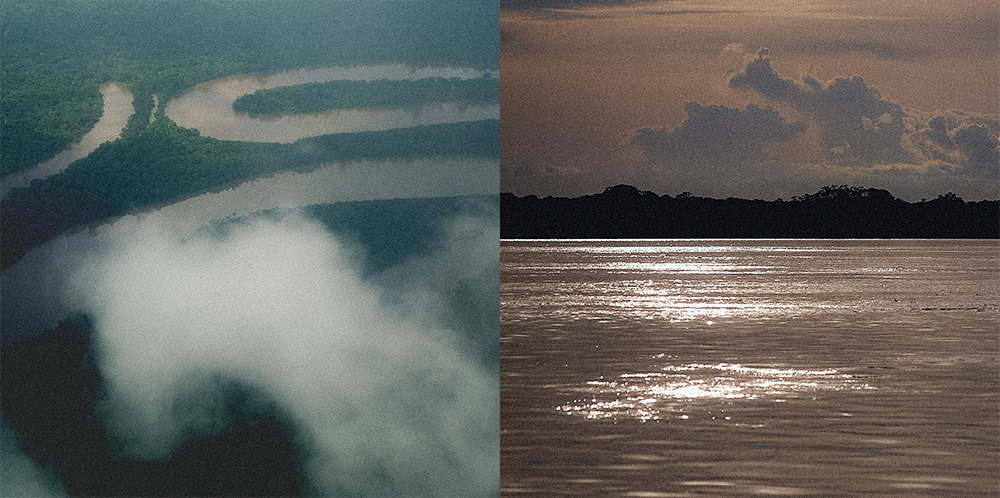
Being there made me feel like a child discovering the world for the first time, with that mixture of wonder, fear, and fascination. The jungle does not only look at you. You feel it looking back. And in that exchange, the visible and invisible stop being opposites. They become part of the same current, like the river.
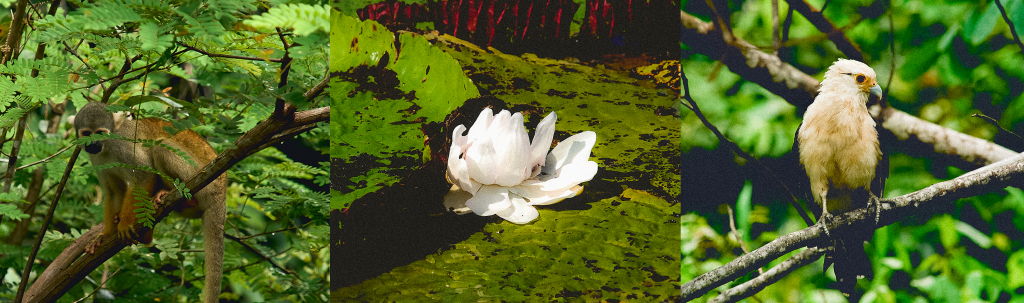
Animals appear constantly in my dreams, and because of that, they appear in my work. Being in the Amazon brought me back to those dreams. It felt like déjà vu. Then, through photography, I was able to make some of those moments physical, to hold them somehow.
Later, speaking with the shaman we met through Delfín about the symbolism and mythology of the animals I had dreamed of and then encountered in real life made the experience feel even more complete.
Traveling by river implies a different sense of time: slow, enveloping, almost circular. How did that cadence affect the way you photographed?
At first, it was hard.
I am impatient by nature. When I arrived, the rain intimidated me. Cameras and torrential rain are not an easy combination. In the Amazon, you are completely at the mercy of Mother Nature. It can rain as if the world is ending, and an hour later there is radiant sun.
It took me a couple of days to fall into the rhythm of the place because I arrived with an agenda. But once I surrendered to the experience, I entered the rhythm the Amazon was setting, and everything started to align.
I learned to feel affection for an overcast sky. And that also made me appreciate the clear moments even more. Those contrasts made everything more intense.
Did the forest force you to let go of compositional control and allow it to set the image’s rhythm?
Completely.
In the Amazon, you understand very quickly that you are nothing and everything at the same time. The territory is so vast, and Mother Nature feels so present, so powerful, that you cannot impose total control over the image.
Mysteries and beings reveal themselves in their own time. You simply have to be willing to observe and listen.
The light changes constantly. Sounds alert you to presences that may or may not appear. So much stays hidden, and that is beautiful too.
I had to learn to wait calmly and watch. I understood that, there, you do not force the image. You discover it.
Delfín offers an intimate experience: low occupancy, silence, and closeness to the environment. How did that scale influence your creative process?
It was wonderful.
My trip was very intimate. I only shared the cruise with my assistant and one foreign couple. We connected deeply, and we still keep in touch. That low occupancy created the feeling of a journey made to measure.
There was a very special calm.
That intimacy lets you slow down. Creatively, having that space mattered. I could move between intense exploration and moments of safe rest.
In the Amazon, the forest feels like it has its own agency. How does the relationship between the human and the environment shift there?
In my work, there is often a tension between the human and the environment. But in the Amazon, I felt the human completely lose its central position.
No single figure dominates the frame. That tension dissolves. It no longer feels like opposition. It feels like fusion.
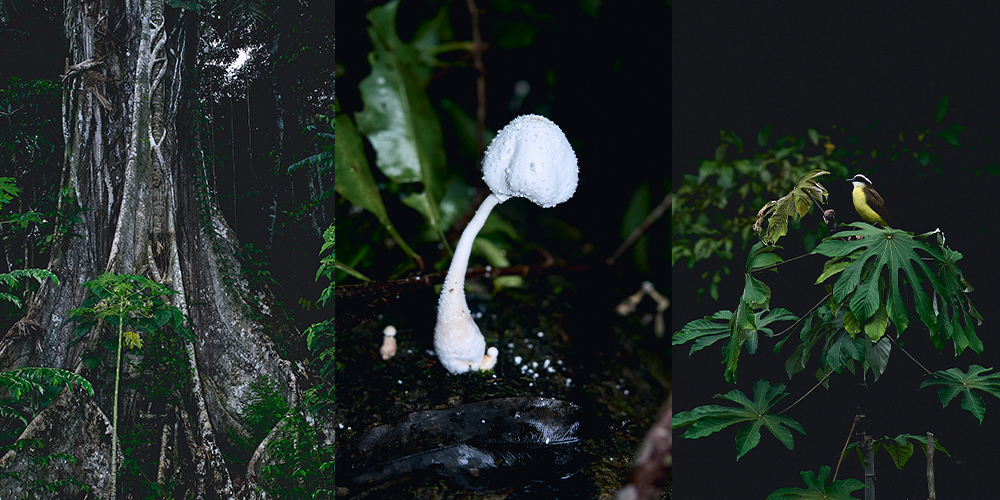
Something I took with me was the idea, present in many Amazonian worldviews, that the hierarchy of species dissolves. Humans, plants, animals, rivers, mountains, and even stones can exist on the same level of importance. Nothing is above or below. Behind each plant, animal, river, or stone, there may be a soul or invisible being. Some communities call them Maninkari: beings that hold the wisdom behind the animated and the inanimate.
I have not tried to illustrate this directly in my work yet, but hearing and understanding it changed the way I perceived the jungle. It helped me see it as a full subject, an active entity with its own agency.
That transformed my images. The landscape was no longer just landscape. It became the complete protagonist. It eclipsed us with its depth and beauty.
There was also something very physical in that perception: green.
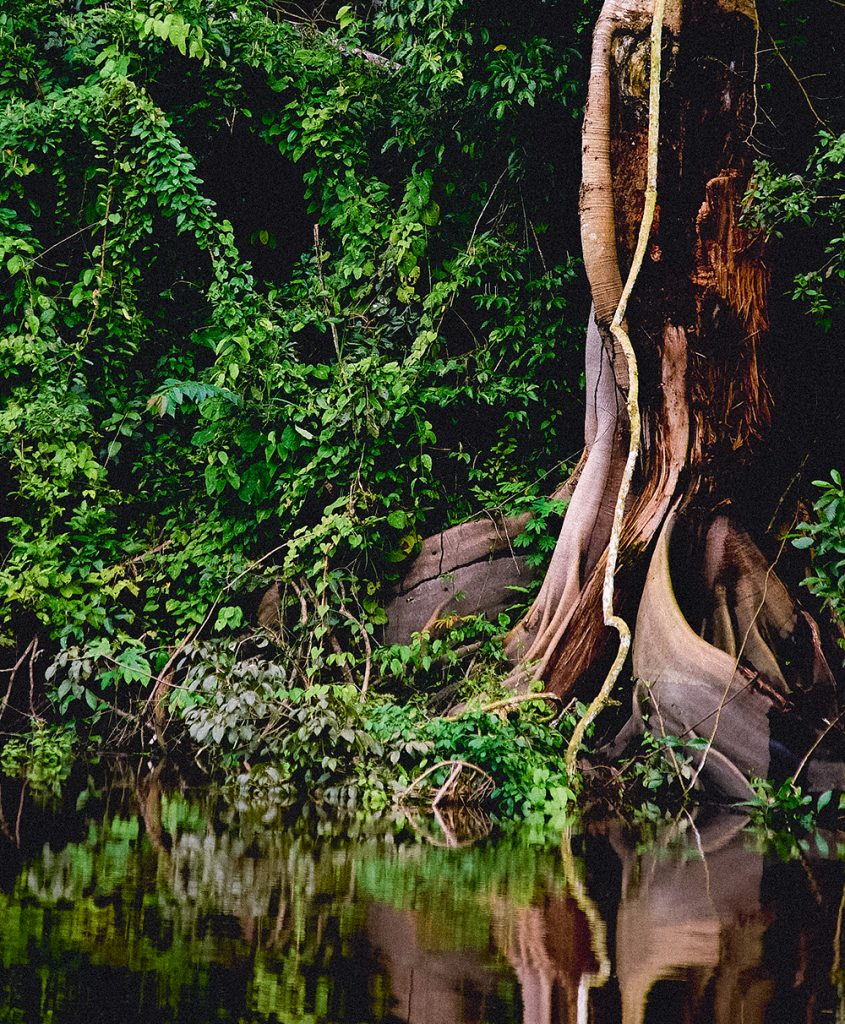
Green has the widest range of tonal variations the human eye can perceive. Being surrounded by that saturation for days sharpened my gaze. I began to notice nuances I would have missed before. Colour became a sensory experience.
Water is a constant protagonist in your visual language: mirror, border, depth, reflection. How does the river dialogue with that?
Water, for me, is everything.
It is purification, teaching, and mystery at once. It teaches you about yourself because it reflects us, but it also hides. We have no idea what truly exists beneath the surface.
As a child, I was almost obsessed with creating images and duplicating them into mirrors. There is something about symmetry that gave me deep visual pleasure. Maybe it was the idea that an image could contain another image inside itself and become whole.
Seeing that happen naturally, when the water was still, felt like entering another dimension.
The river materializes something I have always been drawn to: the coexistence of reality and projection. A reflection is not exactly the same as what it reflects. It is inverted, unstable, almost alive. That instability is what I want to explore. That is where optical illusions happen. That is what I call portals.
I dream often of water: rivers, waterfalls, the sea. Maybe that is why the river feels like such a natural space for the conscious and unconscious to meet.
The Amazon has a unique soundscape: insects, birds, humid silence. Did that acoustic atmosphere influence when you chose to shoot?
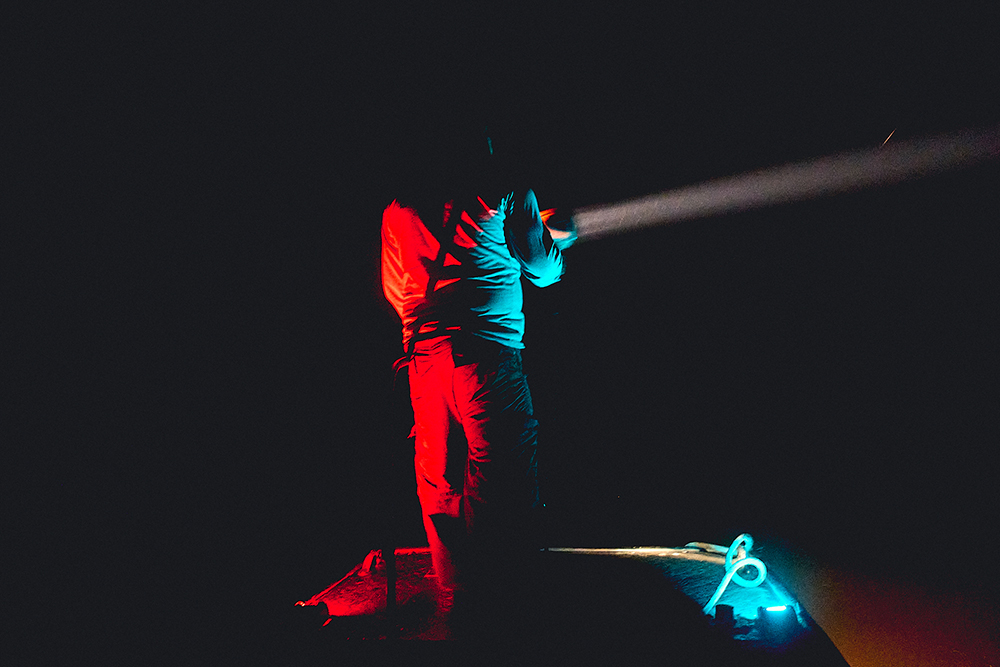
Completely, especially during excursions when we were looking for animals.
Our guide Juan Carlos was wonderful. I grew very fond of him. He taught us so much about how to respect and move through the environment.
Each time he anticipated an approaching bird or animal, it was almost always exactly the species he said it would be. The sound was what made us stop and wait.
That changed my rhythm.
Instead of actively hunting for an image, I had to stay attentive, eyes open, in silence, until something revealed itself among the branches or in the water.
Was there an encounter with naturalists or crew that made you reconsider the artist’s role as an outside observer?
Yes.
The Amazon forces you to understand that you arrive as a visitor in a territory local communities know intimately. They inhabit the space in a way you cannot access from the outside.
Conversations with Juan Carlos Palomino and the crew helped me understand that there are many ways of seeing beyond the artistic gaze. They recognize signals, rhythms, and presences that, for me as a visitor, went completely unnoticed.
It lowers the artist’s ego.
You enter a more receptive state. You begin to listen. It pushed me to look with more humility and to understand that knowledge and sensitivity already belong to the people who live in that territory.
Was there a specific instant that felt like a revelation?
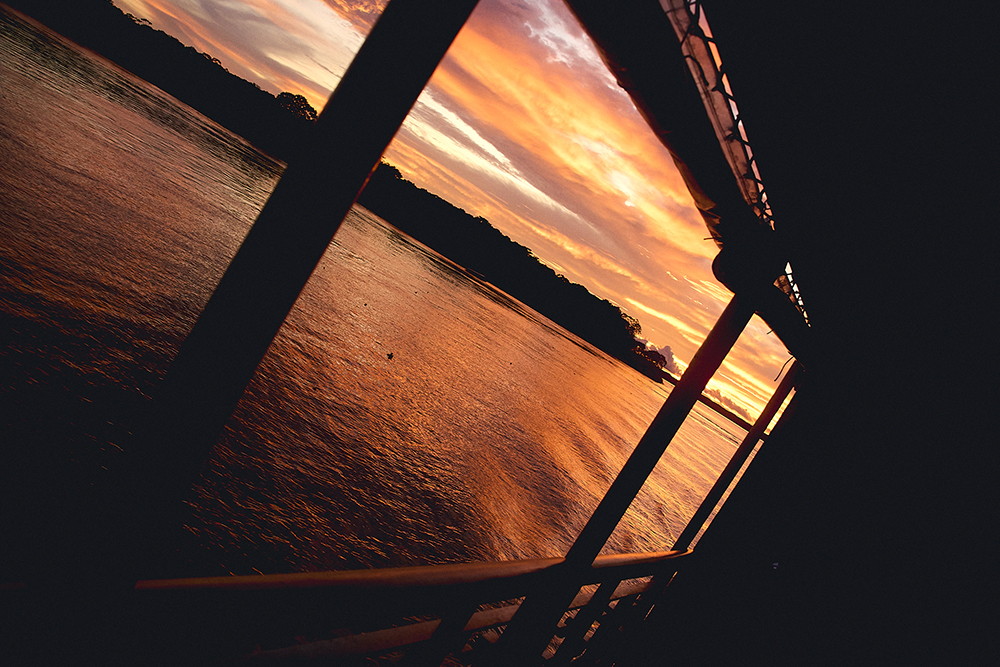
The last sunset I saw there was unbelievable.
It looked like an explosion. The colours were expansive and constantly changing. I would turn for a second to look at the opposite side of the sky, then turn back, and everything had changed again. It became more intense, more red. I felt only gratitude for being there to witness it.
Another moment I will never forget: we were in a kayak, and a baby pink river dolphin jumped less than a metre away.
If you had to describe the Amazon not as a landscape, but as an emotional state, what would it be?
Awe.
A mix of wonder and reverence. Maximum admiration. Contemplation. Constant curiosity.
It is a feeling of becoming very small before something immense. It forces you to be completely present.
Everything amazes you: the light, the absence of light, the sounds, the weather changes, the life that appears, and the life that stays hidden.
It is a constant state of discovery. The Amazon is always one step ahead of you, keeping you in fascination and mystery.
What stays with you from the river now that you have returned?
The river taught me to stay open to surprise and change.
Sometimes we move so quickly through life, so attached to our own objectives, that we forget we cannot control anything. We can only choose how we act and how we respond to what comes.
What remains with me most is this: to be more attentive, more available, and more willing to let things reveal themselves in their own rhythm.
The Amazon is often narrated through spectacle. How should this territory be told today?
It does not need exaggeration or spectacle.
It should be allowed to be what it is. We need to give it the importance it deserves: as a place of immense wisdom, as the home of countless tribes and native communities, each with their own customs, cultures, languages, and ways of understanding the world.
It is also home to an extraordinary part of the planet’s plant life.
We should move away from the idea of conquest, from consuming the landscape, and instead approach it through relationship. We need to meet it as an equal, with respect.
The Amazon is not a stage. It is its own entity: a living, complex territory with its own rhythms and knowledge.
As an artist, my position is only one among thousands inside that weave. From there, I am more interested in suggesting and revealing small moments than in explaining everything. In truth, I know very little.
My ancestry comes from there, but I did not grow up there, and that also defines my position. I am more interested in opening questions than closing them.
Maybe that is enough.
Maybe that is where it begins.