


A Vessel of Remembering: Perú Amazon Rainforest Stories
The river does not observe anniversaries.
On August 9, the world marked the International Day of the World’s Indigenous Peoples. On August 10, the Marañón continued on its course. Macaws crossed the morning sky. Howler monkeys called from beyond the riverbank. Naturalists watched the water and canopy for small changes. In communities along the river, young native plants continued to settle into the soil.
An anniversary can focus attention. The following morning reveals what continues.

Generations of close attention to place have shaped knowledge of water, weather, plants and animals across the Peruvian Amazon. It lives in daily practice, in local names and in stories carried from one generation to the next. It is not an abstract collection of facts, nor does it belong to those who arrive briefly.
Delfín is Peruvian, family owned and shaped by nearly two decades on these waterways. But time in a place does not confer ownership of its stories. Our vessels travel through landscapes and communities whose histories long precede us. Our responsibility is to enter with respect and to make room for travelers to listen.
To travel with Delfín is to arrive as a guest. A guest pays attention before forming conclusions. A guest understands that access is a privilege and that an invitation never becomes possession.
This is what we mean by a vessel of remembering: not Delfín as the keeper of the Amazon’s memory, but Delfín as a space in which travelers can encounter living knowledge responsibly.
Stories are living knowledge
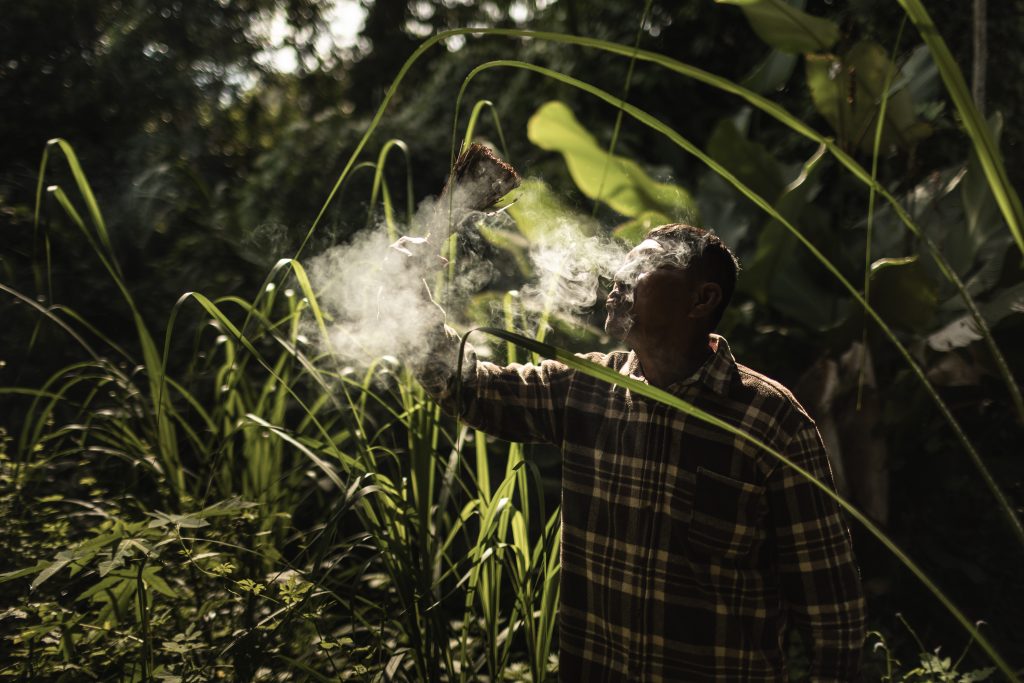
At the end of the day, when the skiffs have returned and the rainforest begins its nighttime chorus, guests find an illustrated story from Cuentos del Amazonas in their suites. These tales draw from regional oral traditions whose origins are specific, even when a story has traveled beyond a single community.
The care with which people carry these tales determines their value. They are not anonymous folklore, decorative entertainment or a shortcut to explaining the Amazon. They are invitations to listen and reminders that every story comes from a particular relationship between people and place.
The pink river dolphin shows why different forms of knowledge matter. During an excursion, a naturalist may explain the animal’s habitat, behavior and the pressures it faces, drawing on observation and on ongoing conservation research with ProDelphinus. Some regional traditions speak of the dolphin as a being able to move between worlds, assume human form or guide a traveler home.
Science helps us observe, understand and protect the natural world. Oral traditions illuminate relationships, values and meaning. Holding both does not make the encounter less precise. It makes clear that no animal exists only as a sighting on an itinerary.
A story shared at bedtime is therefore more than an amenity. Read after a day on the river, it can quietly change what a traveler notices the following morning.
When memory returns to the soil
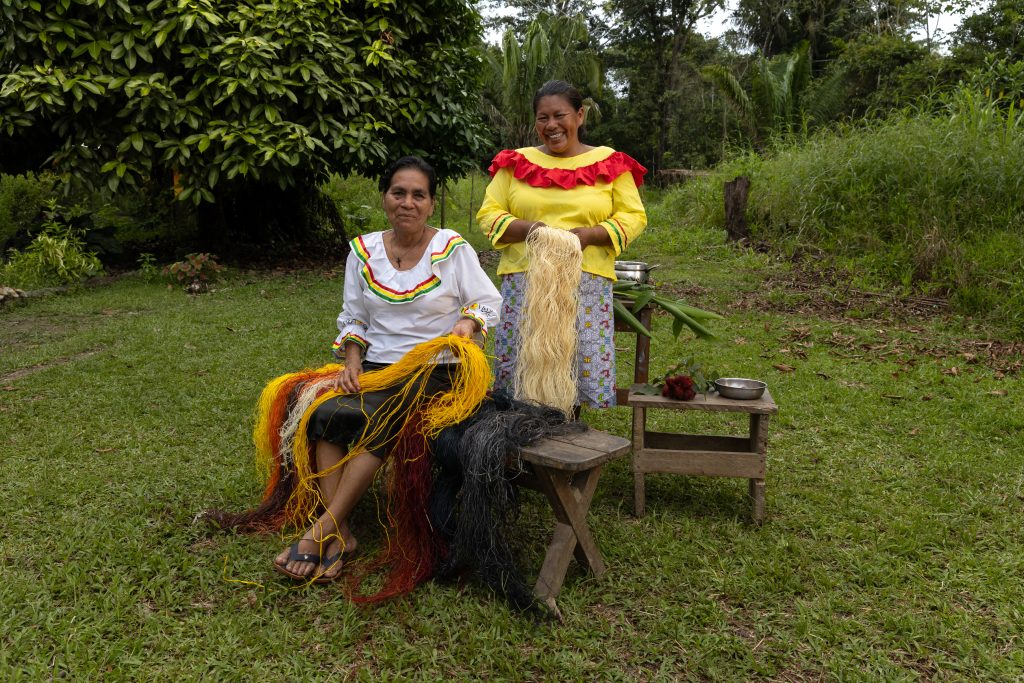
Memory also takes material form through BioRest, Delfín’s biocultural restoration program, launched along the Marañón River in 2025 under the leadership of biologist Gabriela Orihuela.
The program began with participatory agreements with the community leaders of San Francisco, Amazonas and Puerto Prado. Eighteen families joined voluntarily across a 172-hectare restoration corridor. The first phase delivered exactly 1,680 native plants; Delfín’s 2025 sustainability report set a goal of planting more than 3,000 trees and shrubs during 2026.
The work began not by treating degraded land as an empty space awaiting an outside solution, but by asking participating families two questions:
Which plants do you remember growing here? Which ones do you want to bring back?
Their answers helped guide the selection of 17 native species with value for food, medicine, craft and conservation. One community elder remembered leche huayo, and the program is now reintroducing this tree after it became increasingly difficult to find.
The example is small, but revealing. A fruit tree can carry the taste of childhood alongside the promise of future nourishment. A shade tree can influence where people gather during the heat of the day. A plant used for medicine or natural dyes holds knowledge that can disappear from daily life when the species itself disappears.
Why biocultural restoration matters
This is why biocultural matters. Ecological and cultural loss often happen together. A landscape may become greener while remaining culturally poorer if the species that return have little meaning for the people who live there.
Science is essential. It helps determine which species can thrive, how soil can recover and how diverse planting can strengthen resilience. Community memory contributes another form of precision: it identifies what belongs in people’s lives, what communities have lost and what they want future generations to know.
The plants are still young. Their significance comes not only from the day they entered the ground, but also from the care that follows, the shade they will eventually cast and the possibility that a remembered species will become part of daily life again.
What responsible hospitality asks of us

The International Day of the World’s Indigenous Peoples brings rights, cultures and knowledge into public attention. The day after asks a more demanding question: how does that recognition enter the routine of a travel company once the official observance has passed?
Responsible hospitality begins with accuracy: naming people, communities and sources when permission allows, while refusing to present distinct traditions as a single, generalized “Amazonian culture.” Community encounters must be built around local agency, informed consent and fair exchange. Above all, hospitality must never be treated as ownership of a story, an image or a cultural practice.
This responsibility also changes the meaning of luxury. In the Amazon, luxury is not unrestricted access. Instead, it offers the time, space and guidance needed to become more attentive. Comfort should not compete with the river. The true privilege lies in entering a remote landscape while recognizing how much knowledge already exists there and how much will remain beyond our understanding.
Work grounded in relationships is never finished. It requires listening over time, including when what we hear changes our assumptions about conservation, hospitality or the role of travel itself.
What remains the following morning

This morning, the Marañón carried on. So did memory.
It moved through a naturalist’s name for a bird, through a story read before sleep and through a seedling chosen because someone remembered the tree it could become. The river and the communities along it carry that memory. Delfín’s role is more modest and more demanding: to move with the river, work alongside its communities, create space for attention and help protect the conditions in which living knowledge can continue.
That is the journey we invite our guests to join: not to possess the Amazon, but to enter as guests of a place that was alive, storied and deeply known long before they arrived.
August 10, 2026