


BIRDWATCHING IN THE PERUVIAN AMAZON: MACAWS, PARROTS, AND THE LANGUAGE OF THE CANOPY
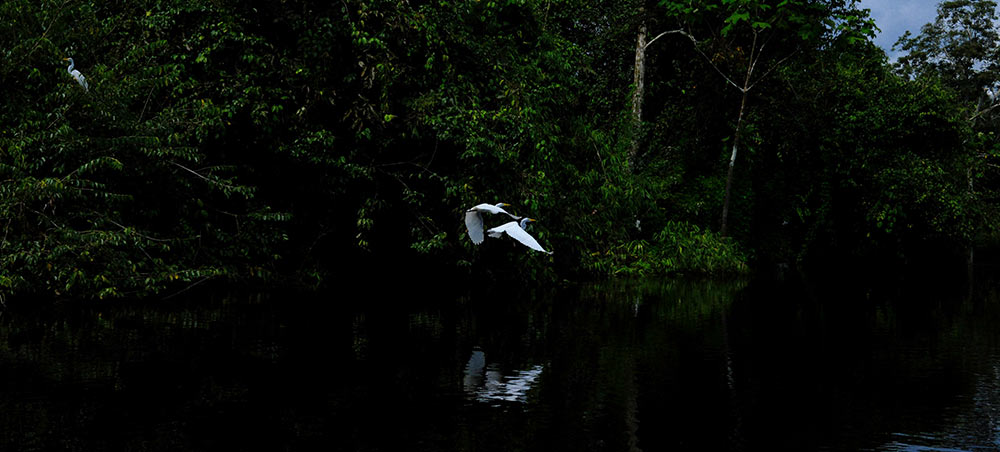
There is a moment in the Amazon when the day begins before the light does.
The river is still dark. The forest is not. Somewhere inside the canopy, a first call breaks the surface of the morning. Then another. Then a chorus begins to move through the trees: wings, whistles, shrieks, clicks, liquid notes, sudden silences. The sky softens. The water turns silver. What seemed like a wall of green becomes a living architecture of movement.
To travel through the Peruvian Amazon is to enter a world where birds are not background. They are signals. They are weather, distance, territory, warning, courtship, memory. They announce the hour before a clock can. They reveal where fruit is ripening, where water is shifting, where something has moved unseen.
Aboard Delfín Amazon Cruises, birdwatching is not a separate activity from the journey. It is one of the ways the rainforest teaches you to pay attention.
Each suite is equipped with binoculars, allowing guests to observe the forest from the privacy of their room, from the observation deck, or during quiet moments between excursions. On every outing, Delfín’s expert naturalist guides accompany guests through the waterways and forest trails of the Peruvian Amazon. Their role is not only to identify species, but to help interpret the landscape: the calls, movements, feeding patterns, nesting behaviors, and subtle signs that reveal where birds are likely to appear.
In a place as layered as Pacaya Samiria National Reserve, this guidance changes everything. The Amazon is generous, but it is not obvious. With trained eyes and ears leading the way, what first appears as dense green begins to open into a living map of sound, color, and movement.
The forest above the river
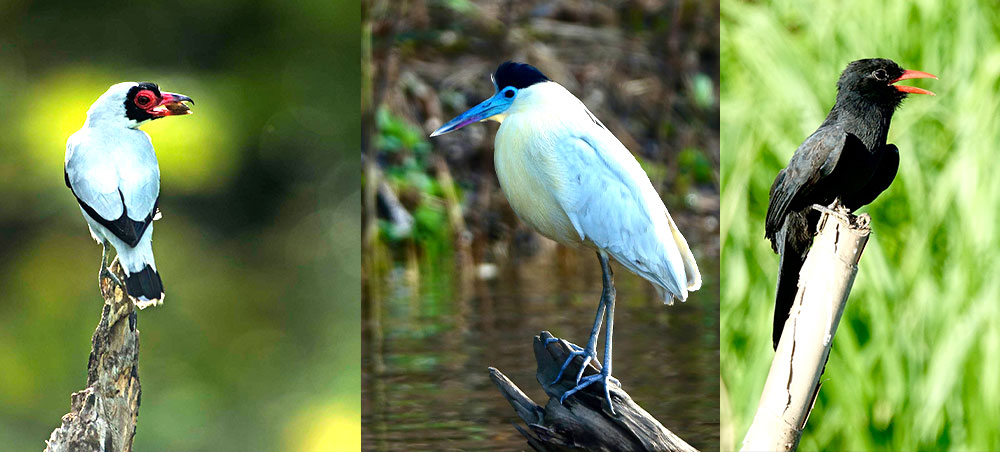
The Peruvian Amazon is one of the richest birding regions on Earth. In Pacaya Samiria National Reserve, the vast protected landscape where Delfín journeys unfold, hundreds of bird species have been recorded across flooded forests, blackwater lagoons, riverbanks, islands, and canopy corridors.
This is what makes an Amazon wildlife tour here feel so alive: the landscape is constantly changing, and the birds move with those changes. During high water, the forest opens by boat. Skiffs glide between tree trunks and under branches where kingfishers wait, herons lift from the shallows, and parrots cross overhead in bright, noisy groups. During low water, exposed banks and forest trails reveal another rhythm: prints in the mud, feeding grounds, nesting areas, and birds moving between river edge and interior forest.
Birdwatching in the Amazon is not only about collecting sightings. It is about learning how much of the forest lives above eye level, and how much can be understood by sound before it is seen.
Macaws: Color with a voice
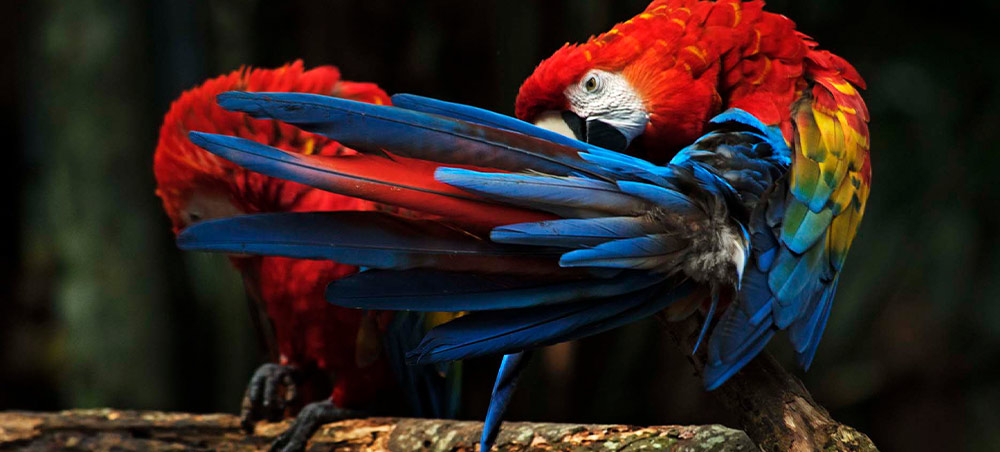
Macaws are among the great emblems of the Amazon, but seeing them in flight is different from recognizing them in an image.
Their color does not sit still. Scarlet, blue-and-yellow, and red-and-green macaws move through the canopy like fragments of weather. They often appear in pairs or small groups, crossing the sky with long tails, strong wingbeats, and calls that travel far beyond the bend of the river.
There is nothing delicate about their presence. Macaws are intelligent, social, and unmistakably loud. They belong to the forest not as decoration, but as active participants in its ecology. They feed on fruits and seeds, help shape dispersal patterns, and move through the upper layers of the rainforest with a confidence that makes the canopy feel inhabited rather than distant.
For guests on an Amazon river cruise in Peru, the first macaw sighting often becomes a marker in memory. Not because it is rare to speak of color in the Amazon, but because this color has force. It has sound. It has direction.
Parrots and Parakeets: The forest in conversation
Parrots and parakeets are some of the Amazon’s most social residents. Their calls can seem chaotic at first: sharp, overlapping, insistent. But the more time you spend listening, the more the noise begins to feel like structure.
They travel in groups, gather in trees, move between feeding sites, and announce themselves with the confidence of creatures who know exactly where they are going. Mealy parrots, yellow-crowned parrots, cobalt-winged parakeets, and many other species may appear along the route, depending on season, water level, and the path of the day.
Delfín’s naturalist guides are essential here. They do more than identify a bird by name. They help translate behavior. They know the difference between a passing flock and a feeding tree, between a call worth following and a sound already moving away. In a place where life often hides in plain sight, this kind of knowledge changes the entire experience.
The Amazon does not reveal itself to urgency. It rewards patience, trained ears, and the willingness to look again.
The Hoatzin: An ancient oddity at the water’s edge
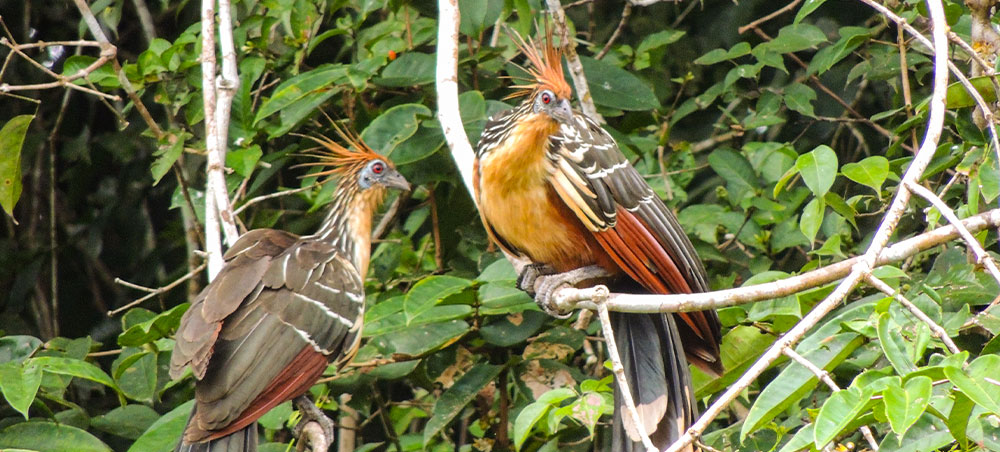
Not all Amazon birds are elegant in the expected way. Some are stranger, older-feeling, almost impossible to place.
The hoatzin is one of them.
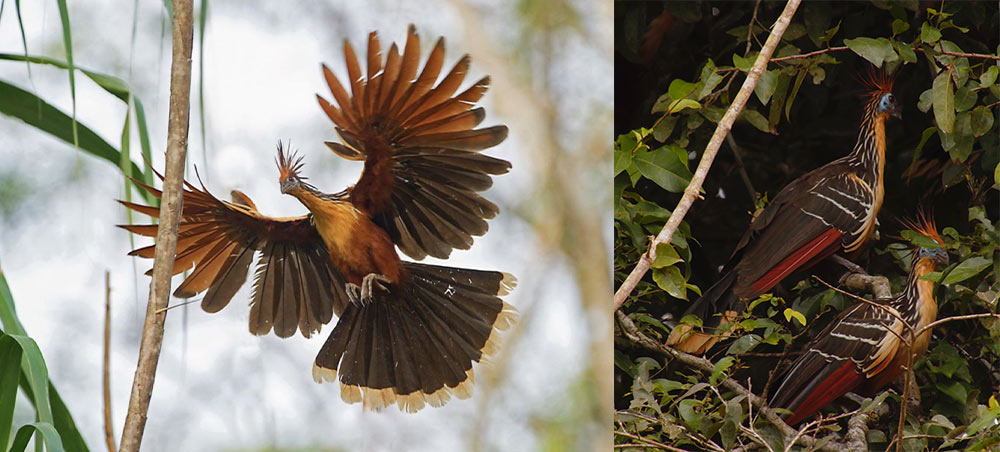
With its spiky crest, blue face, rust-colored feathers, and prehistoric attitude, the hoatzin looks like a bird assembled from another time. It is often found near waterways, perched among branches and vegetation, moving slowly, feeding on leaves, and making its presence known with a rough, unmistakable sound.
Its digestive system is part of its legend. Unlike most birds, the hoatzin ferments plant material in a specialized foregut, a process that contributes to the odor behind its nickname, the “stinkbird.” But the nickname undersells it. The hoatzin is not a curiosity because it smells unusual. It is fascinating because it reminds us that evolution is not always smooth, pretty, or easy to classify.
To see one from a skiff in the flooded forest is to feel, briefly, that the Amazon is not ancient in a metaphorical sense. It is ancient in the body.
Kingfishers: A flash above the water
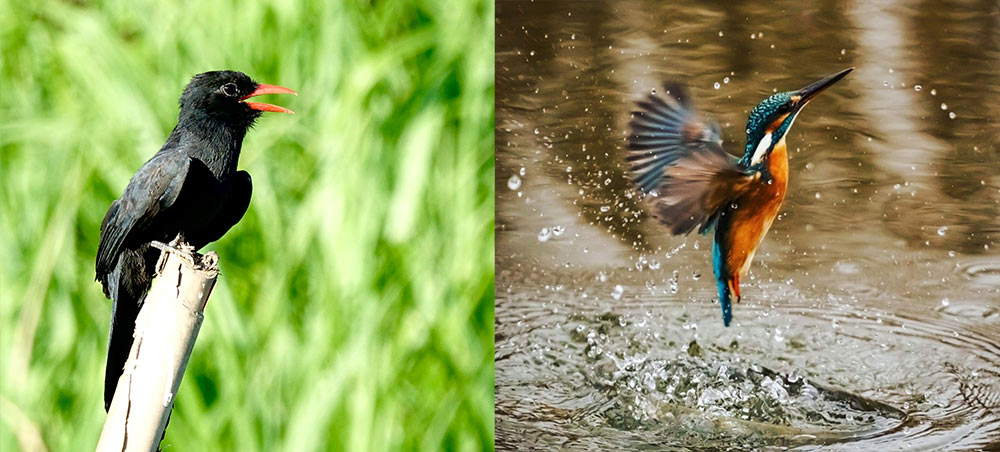
Kingfishers belong to the river’s edge.
They wait on branches, posts, and low limbs, perfectly still until they are not. Then comes the plunge: a sudden streak of blue, green, white, or rust toward the surface of the water. A dive. A splash. A return.
Several kingfisher species inhabit the Amazon, including the Amazon kingfisher, often recognized by its green plumage and strong profile. They are among the birds guests frequently notice first because they work the same visual line as the traveler: the meeting point between water and forest.
On board a luxury Amazon river cruise, it is tempting to think the spectacle will always be large. Dolphins, monkeys, sunsets, storms. But sometimes the most compelling sight is smaller and sharper: a kingfisher waiting with absolute concentration, reading the river through the smallest movement below.
Herons, Hawks, Toucans, and the wider chorus
Macaws and parrots may claim the drama, but the birdlife of the Peruvian Amazon is much wider than its most famous colors.
Herons stalk the shallows with a slow, deliberate grace. Toucans move through the canopy with improbable silhouettes. Hawks trace the sky above the riverbanks. Jacanas step across floating vegetation. Cormorants dry their wings. Swallows cut low over open water. Vultures circle high above the heat. Some birds are seen for a second. Others accompany the river for an entire afternoon.
This is where Pacaya Samiria Reserve becomes more than a destination. It becomes a field of attention. The reserve’s flooded forests, lakes, channels, and river systems create many habitats within one journey, which is why a single day can hold so many kinds of bird encounters.
For travelers searching for an Amazon rainforest Peru experience, this matters. The richness is not only in the number of species. It is in the variety of ways the forest asks to be observed.
Why early morning matters
Birdwatching in the Amazon begins early for a reason.
At dawn, the heat has not yet settled heavily over the forest. The air is softer. The calls are clearer. Many birds are active, moving between roosting, feeding, and nesting areas. The first skiff excursion of the day often carries a particular atmosphere: coffee still warm in the body, mist rising from the water, binoculars ready, everyone speaking more quietly than usual.
Late afternoon brings another window. The light lowers. Birds return, gather, cross, call. The forest shifts again from activity into evening. For those willing to watch carefully, these transitional hours can be among the most memorable of the journey.
Delfín’s itineraries are shaped around these rhythms. Excursions are not imposed on the rainforest from the outside. They follow the logic of the place: water level, weather, light, animal movement, and the knowledge of guides who understand that timing is part of interpretation.
Birdwatching from the deck
Not every sighting requires an excursion.
One of the quiet pleasures of traveling aboard Delfín is that the birdwatching continues from the vessel itself. Each room includes binoculars, so guests can keep watching from their suite, the dining room, or the observation deck as the river carries the journey forward.
Birds cross above the water. Herons appear along the banks. A raptor may hold the sky. A flock may pass just as breakfast is being served. With expert naturalist guides on board to help identify species and explain their behavior, even these in-between moments become part of the experience.
This is one of the subtle differences between arriving in the rainforest and moving with it. On a Peruvian Amazon river journey, the landscape does not pause when you return on board. The vessel becomes another place from which to listen.
Comfort does not have to mean separation. At its best, it allows for deeper attention.
How to watch well
Birdwatching in the Amazon is not about chasing the forest into performance.
The better posture is quieter. Wear neutral colors. Move slowly. Avoid sudden noise. Let the guides lead the rhythm. Use binoculars, but do not let equipment replace presence. Listen first. Look second. Allow your eyes to adjust to layers: waterline, understory, canopy, sky.
Some birds will announce themselves. Others will require patience. Some will be named immediately. Others may remain a flash of movement, a call from somewhere just out of view. That is part of the truth of the Amazon. It is generous, but it is not staged.
The most meaningful encounters often come when the traveler stops trying to consume the landscape and begins to read it.
A journey into the living canopy
A Delfín journey through the Peruvian Amazon is many things: river travel, cuisine, design, conservation, culture, rest. But it is also an invitation into a more precise form of attention.
Birds make that invitation audible.
They wake the forest. They cross the river before the sun has fully risen. They turn the canopy into language. They remind us that the Amazon is not a single image, but a living system of calls and responses, flights and returns, presences and disappearances.
For experienced birdwatchers, Pacaya Samiria offers extraordinary richness. For first-time visitors, it offers something just as valuable: the chance to discover that birdwatching is not only about birds. It is about learning to see the rainforest as alive in every direction.
Join Delfín Amazon Cruises for an Amazon river cruise in Peru and enter one of the world’s great birdwatching landscapes, where macaws, parrots, hoatzins, kingfishers, hawks, herons, and countless other winged lives move through the morning like messages from the forest itself.
July 07, 2026