


One Year of BioRest: The Seeds We Planted Together
By Gaby Orihuela, Sustainability Lead at Delfín Amazon Cruises
A year ago, we began something that felt, in equal measure, simple and enormous.
As a tropical biologist, I have spent much of my life working in forests: studying primates and other mammals, documenting tropical plants, and helping validate restoration projects across Latin America. That experience has taught me that restoring a forest is never simply a matter of putting plants back into the ground.
A forest is made of relationships, functions, and memories. When people have lived alongside it for generations, restoration must include them, not as observers or beneficiaries, but as partners.
This understanding gave rise to BioRest, Delfín Amazon Cruises’ long-term commitment to the people of the Peruvian Amazon, the lands they call home, and the extraordinary biodiversity with which they share them.
A journey built on consent and mutual learning
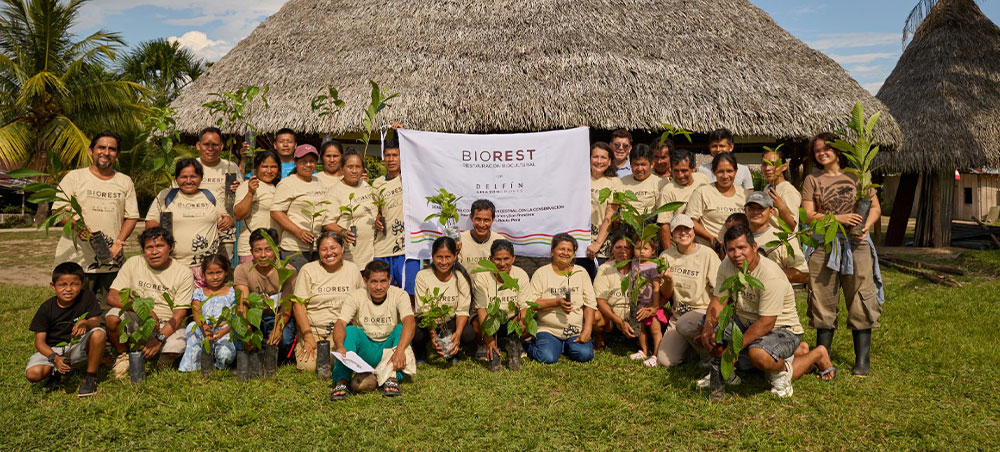
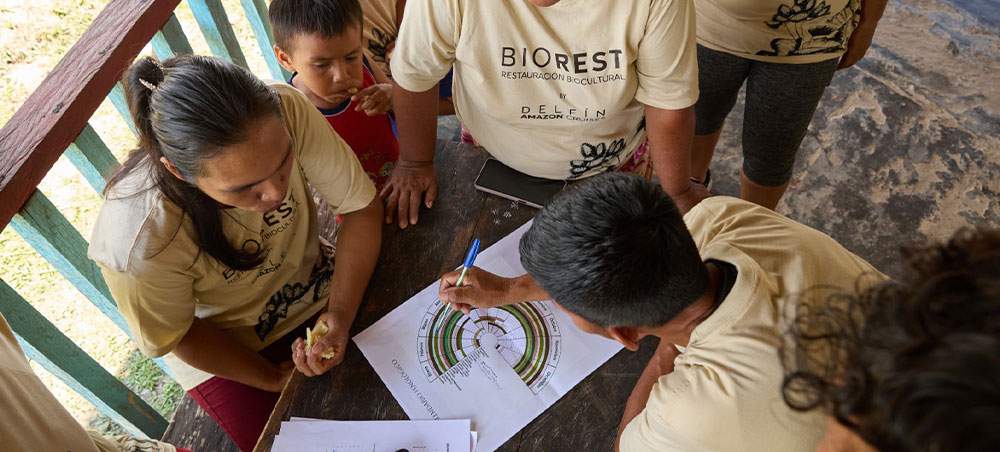
In August 2025, the BioRest team began a series of monthly Community Field Schools along the lower Marañón River, part of the wider Peruvian Amazon River landscape.
We approached three communities that have long been friends of Delfín: Puerto Prado, Amazonas, and San Francisco. We introduced ourselves, shared our vision, and extended an invitation that perhaps they had not expected. Most importantly, we listened. We answered questions and welcomed both curiosity and doubt.
We asked whether the communities wished to join a voluntary process of mutual learning: one that would reconnect traditional knowledge and memories of plants with innovative horticultural practices, while helping native plants that had gradually disappeared from their lands return for the benefit of future generations and the forest itself.
Each community took the proposal to its assembly. A month later, they returned with an answer I will always remember:
“Yes, we want to be part of this journey.”
The decision was reached by consensus. For the first time, Delfín signed commitment agreements with communities for a long-term restoration program.
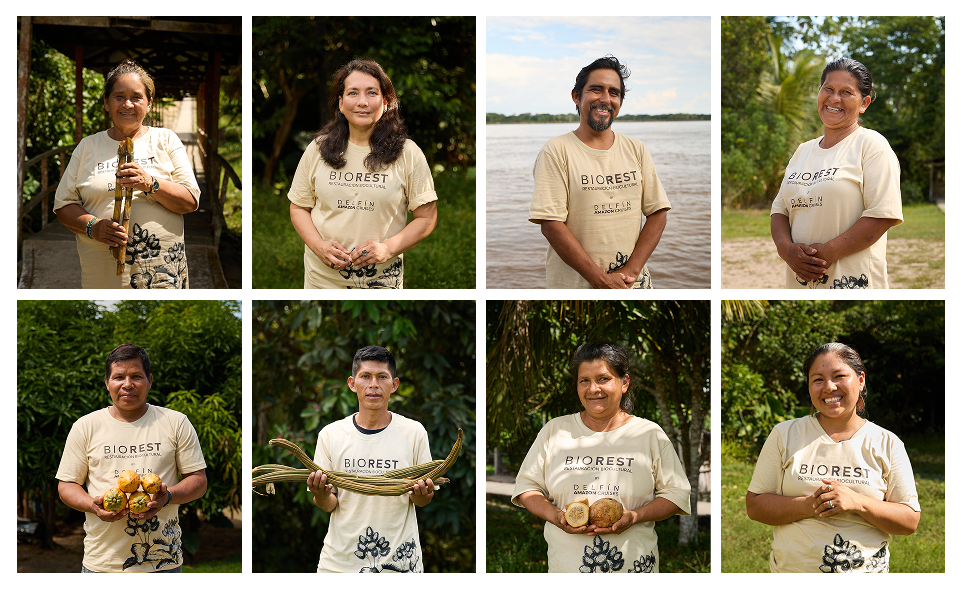
Today, BioRest brings together 18 participating families across these three communities.
Restoring useful native plants and the knowledge around them
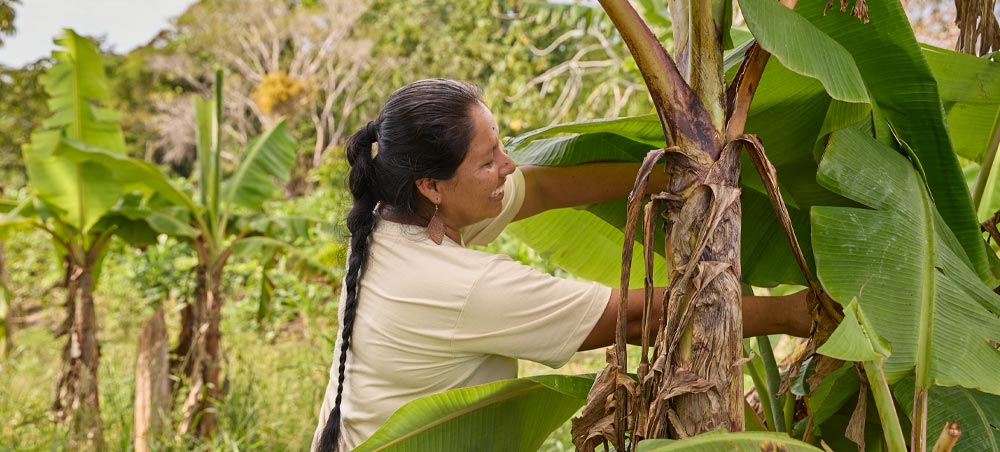
BioRest focuses on recovering useful native plants through agroforestry on abandoned agricultural parcels. The planting strategy brings together species valued for food, medicine, artisanal crafts, conservation, and potential biocommerce.
Our aim is not simply to restore vegetation. It is to explore how native plants can strengthen community well-being, sustain biodiversity, and create possibilities for the future.
Perhaps the most meaningful result of this first year, however, cannot be measured in hectares or seedlings. It is the relationship we have built with the families.We have come to know their homes, their stories, and their children. We have watched the work become a family activity. Caring for a parcel is not the responsibility of one person alone: partners and children join in planting, building, observing, and protecting. The commitment feels genuine because the process has become their own.
The communities have also reminded us that restoration requires patience.
They know how long a plant may take to grow, when it will flower, and when it might finally bear fruit. They nurture young seedlings, protect them from pests and the demanding Amazonian environment, and use natural fertilizers and biological pest-control preparations. There is a special kind of excitement when a plant absent for years begins to return to the land.
I often think back to a moment during one of our workshops, when families were choosing what they wanted to grow. An elderly woman asked, “Can we plant a lupuna?”
My heart burst with joy. That is the spirit of BioRest, I thought.
She knows that a lupuna can take many decades to become a forest giant, long after she is gone. Yet she was not thinking only of herself. She was thinking of her descendants and of the spiritual meaning that tree could carry for generations.
What BioRest’s first-year numbers mean
After its first year, BioRest has brought together:
- 18 participating families in three communities;
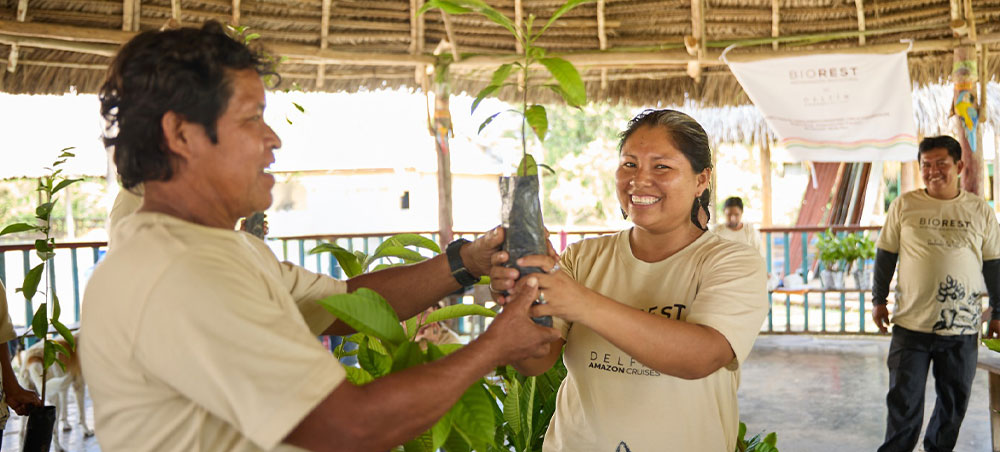
- 1,760 individual native seedlings planted during the program’s first phase;
- a goal of more than 3,000 planted individuals by the end of 2026; and
- a 172-hectare restoration corridor linking the landscapes of Puerto Prado, Amazonas, and San Francisco.
These measurements describe different things and should not be confused.
The figure of 1,760 refers to individual seedlings placed in the ground, not to 1,760 different species. Those seedlings represent a growing collection of useful native plant species, but the number of species is a separate measure.
Similarly, the 172 hectares do not represent an area already planted from edge to edge. They describe the broader corridor formed by the participating parcels and the surrounding landscape that BioRest seeks to reconnect and restore over time. Within that corridor, planting and stewardship advance gradually: family by family, parcel by parcel, and seedling by seedling.
Our target of more than 3,000 by the end of 2026 also refers to individual plants established through the program. Reaching that number will mark progress within the corridor, not the completion of restoration across all 172 hectares. Ecological restoration is a long process, and planting is only its beginning.
Restoration as an exercise in trust
This first year has taught me that restoration is also an exercise in trust.
The seedlings matter. The hectares matter. The data matter. But equally important are the knowledge carried by elders, the curiosity of children, and the willingness of families to care for something whose greatest benefits may belong to the future.
The work asks something of everyone. From the beginning, participating families and our technical team, including engineers Pedro Paucarcaja y Teresita Ruiz, understood that caring for the plants would add a weekly responsibility. It is an investment of time and effort whose rewards will emerge over the medium and long term.
Rather than treating this responsibility only as a burden, families have embraced it with enthusiasm.
Along the way, something beautiful has happened: conversations about plants have brought memories back to life. Community members have recalled plants their elders once used for common ailments. At the same time, they have reflected on their growing dependence on modern medicines, which can require long journeys to obtain.
As a result, ideas such as creating seed banks to safeguard food plants during periods of scarcity, or establishing ethnobotanical gardens closer to people’s homes, have become much more than restoration activities. They offer ways for families to reconnect with knowledge that was once woven into everyday life.
Learning from knowledge already rooted here
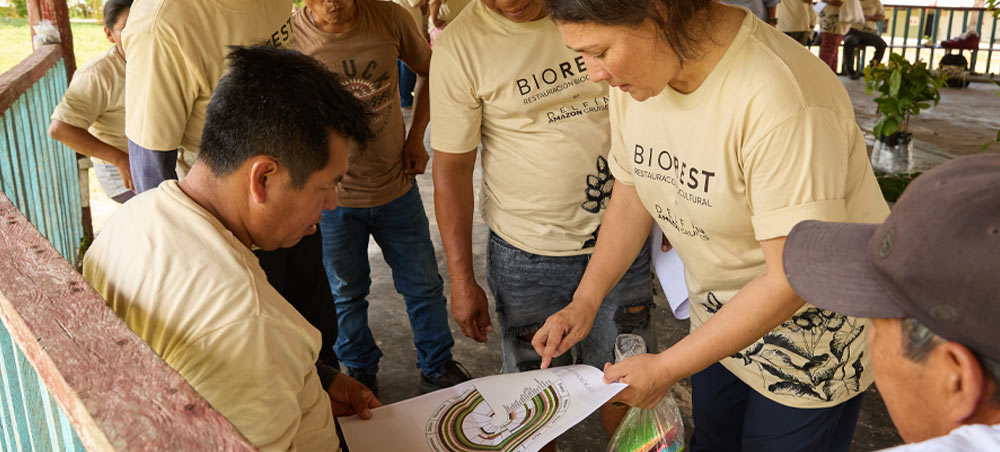
Our monthly Community Field Schools have shown us that creating a space for learning can open doors we never anticipated. Every gathering generates new questions and interests on both sides.
During this process, we learned that the concept of a seed bank has a Kukama name: Muju. Elders know the practice, although it is now underused.
Discoveries like this remind us that the learning is genuinely mutual. We are not arriving simply to bring knowledge to the communities. Together, we are recovering knowledge that has been present all along.
Families are also becoming curious about native plants with biocommerce potential. They ask how market trends might translate into future income and whether these plants could create sustainable economic opportunities.
This curiosity is precisely what we hoped BioRest would nurture. The program is not intended to prescribe a single path. It seeks to create the conditions in which communities can explore possibilities of their own.
Connecting restoration, research, and local opportunity
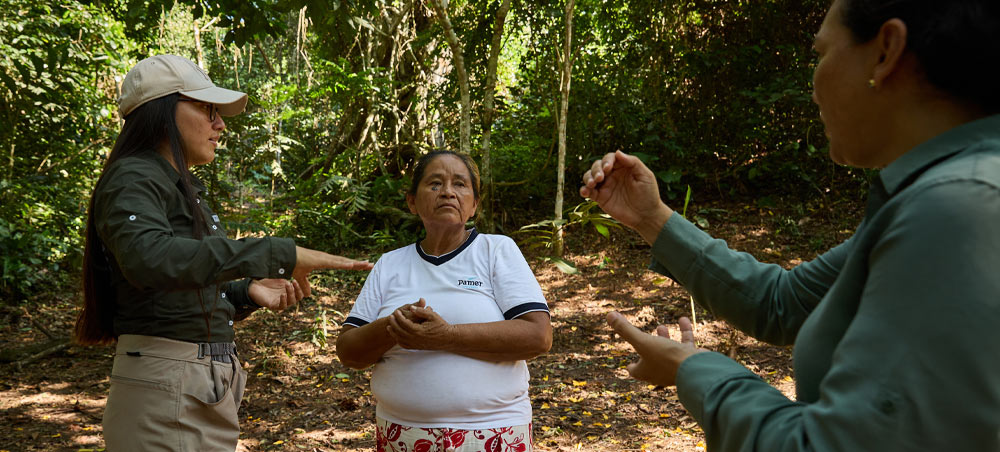
Another encouraging lesson has been the value of linking restoration with knowledge generation.
Through BioRest, Delfín supported its first fellowship, contributing to a local bachelor’s thesis focused on biodiversity and ecological restoration. What began as a research opportunity could ultimately benefit an entire community by expanding local knowledge, supporting positive outcomes for biodiversity, and examining how conservation might develop into meaningful economic activity.
For me, this reinforces an essential principle: successful restoration is measured not only by what grows in the soil, but also by the relationships, knowledge, and possibilities that grow alongside it.
The seeds we carry forward
As our boat headed back to Nauta after the celebration of BioRest’s first anniversary, I found myself thinking about the fate of the seeds not only those we had placed in the earth, but also the seeds of knowledge, responsibility, and possibility planted among us.
We are still at the beginning.
Yet I believe that if we continue listening, learning, and growing together, BioRest can become more than an Amazon rainforest restoration program in Peru. It can become a living example of how tourism can contribute to the long-term health of the Amazon not by speaking for its people, but by walking alongside them.
At Delfín, we renew our commitment to this journey: to the river, to the forest, to the people who call it home, and to all the extraordinary lives that depend upon it.
Thank you for joining us on this journey of renewal.
September 01, 2026