

Tasting the Amazon at Masi in Lima
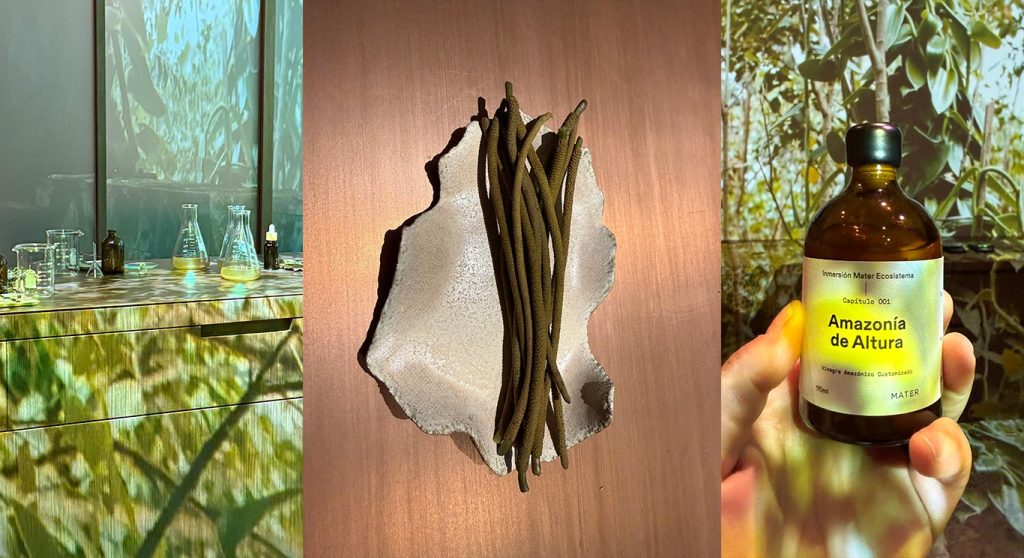
At Masi in Barranco, the first encounter with the Amazon comes through a small piece woven from chambira, a palm fiber. Held close to the nose, it invites attention to aromas before any ingredient is tasted. The woven material is itself part of the forest. Even this first object offers more to consider than the scent it carries.
For travelers returning to Lima after an Amazon river cruise with Delfín, the experience offers a way to continue looking at the plants and foods encountered along the river. A familiar flavor can prompt a question that did not occur in the forest. A leaf can change the way a finished food is understood.
Masi brings the work of Mater, the Instituto Mater de Ciencias Bioculturales, to the public through experiences, foods and objects. Mater studies the relationships between people and biological resources; its research also informs the kitchens of Central and Kjolle. At Masi, visitors can spend time with the materials and processes behind that work.

Inside Casa Mater
Inmersión Mater Ecosistemas, Cap. 001: Amazonía de Altura takes place in the Senses Room at Casa Mater in Barranco. Its focus is the high Amazon, or selva alta. For a traveler arriving from the river, this is an opportunity to encounter another part of the Amazon and consider how ingredients relate to the places where they grow.
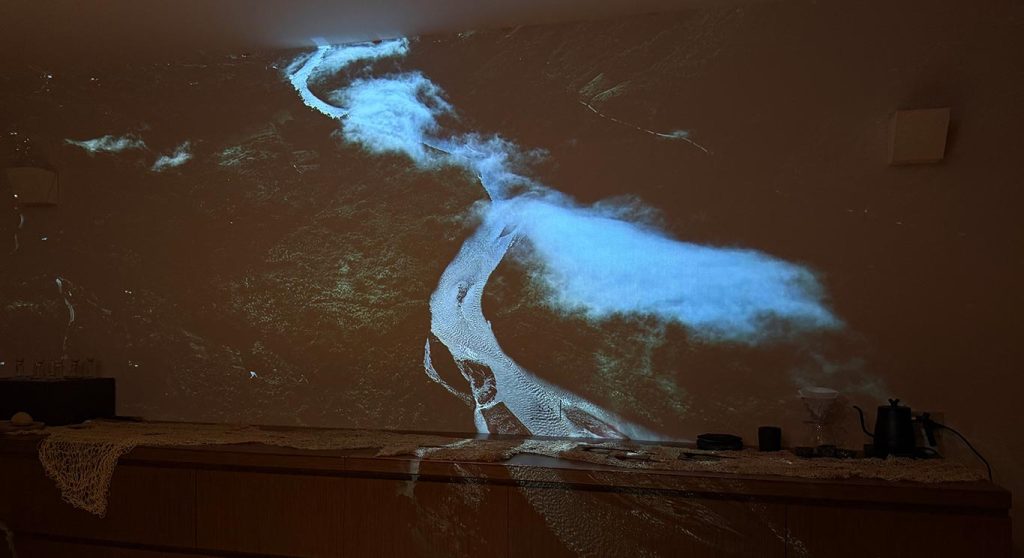
Field recordings and projections accompany the tasting. Sounds and images return attention to the territory around an ingredient, while the guided exploration considers its origins and the knowledge associated with its use. A flavor is easier to remember than the work that makes it available. Giving both room in the same experience helps keep them connected.
The tasting follows four groups: plants and barks, fruits and vegetables, nuts and palm fruits, and chillies and peppers. Ingredients appear in their natural state and in different preparations. Visitors compare the effect of each process on aroma, texture and intensity. The selection changes with the season and the progress of Mater’s research.

Vanilla, camu camu, Brazil nut and pipilongo were among the ingredients in the visit that prompted this article. Camu camu brought a sharp acidity; the Brazil nut was creamy and earthy. Pipilongo had warmth and an unexpected menthol quality. These impressions offer a starting point. Tasting the same ingredient in another form can complicate the description that seemed sufficient a moment earlier.
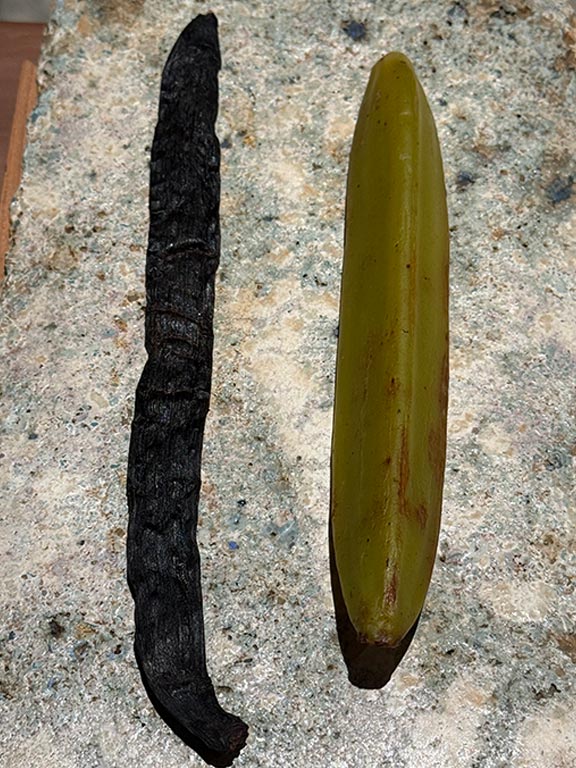
Vanilla is especially revealing because its flavor is so familiar. Recognition can end curiosity too soon. The word calls up a taste long before it brings to mind a growing plant, its surroundings or the work involved in preparing it for use. Encountering Amazonian vanilla in this setting gives those less familiar details a place beside the aroma.
The plant behind the chocolate
A green chocolate made with cacao leaves asks for a similar adjustment. Chocolate is usually understood through the seed and what happens to it during processing. The leaf directs attention to parts of the plant that rarely enter that account.
Mater’s wider research into Theobroma includes cacao and its relatives, copoazú and macambo. Researchers work with pulp and husks as well as seeds, and explore leaves and flowers. The resulting experiments include foods and drinks, alongside biomaterials. The green chocolate tasted in Amazonía de Altura offers a small, specific example of what that research can produce.
There is a responsibility in describing such encounters. An ingredient unfamiliar to a visitor may be part of everyday knowledge for the people who grow or gather it. Surprise belongs to the person tasting. The plant and its uses have a history that precedes that moment. Keeping origin and local knowledge in the conversation gives the experience more substance than a succession of unusual flavors.
An experience that continues at home
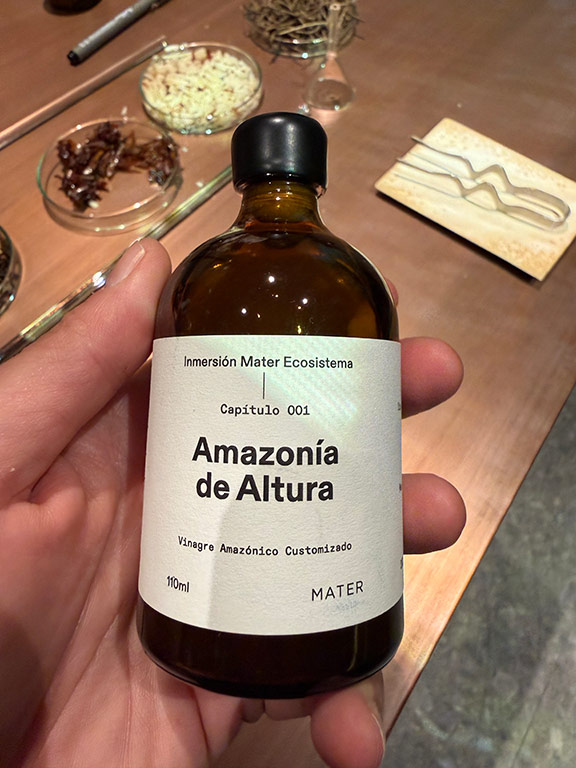
The session closes with a personalized vinegar preparation. Participants choose up to two ingredients, weigh them and add them to the vinegar before labeling it. Maceration continues at home as the ingredients steep. The choice involves thinking about how flavors might complement one another or create a contrast, then allowing time for the result to develop.
That attention to process has a connection to travel with Delfín. On the river, naturalists help guests recognize details that can be difficult to distinguish at first. Learning about a plant’s uses gives a reason to remember it. Masi offers another setting for that kind of attention, with time to compare an ingredient before and after it has been prepared.
A visit to the Amazon leaves questions that can be pursued elsewhere. In Lima, some take a practical form: a cacao leaf made into chocolate, a familiar vanilla aroma considered alongside its origin. The vinegar taken home adds another. Its ingredients remain in the bottle, slowly changing the taste of what surrounds them.