


Why we travel
Curiosity, connection and the call of the Amazon
There is a moment at the beginning of a journey when the familiar starts to fall away.
The suitcase is closed. The door is locked. The routines that usually organise our days are left behind. We may not have travelled very far yet, but already something has shifted.
Perhaps this is where travel really begins.
Not with distance, but with attention.
At home, we become very good at knowing. We know which way to turn, what time things happen, what to order, what the day is likely to bring. There is comfort in this familiarity, but there is also a danger. When we know a place too well, we can stop looking at it.
Travel makes us look again.
Pico Iyer once wrote that we travel first to lose ourselves and then to find ourselves. There is truth in that, although perhaps there is another possibility too.
Perhaps we travel to become less certain.
Once again, we become beginners.
Questions replace assumptions. We listen more carefully and begin to notice how breakfast is prepared, how people greet one another and how a landscape changes with the hour. Familiar words escape us. Sometimes, we must wait for someone else to show us the way.
And sometimes, if we are fortunate, we encounter a place that resists our desire to understand it quickly.
The Amazon is such a place.
Entering a world of water
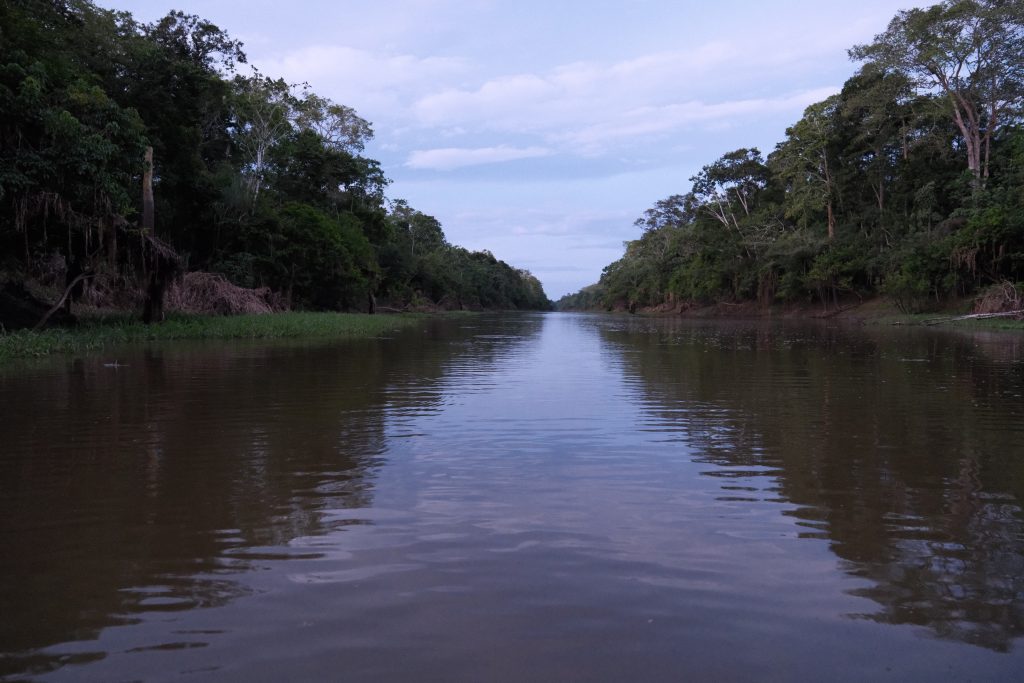
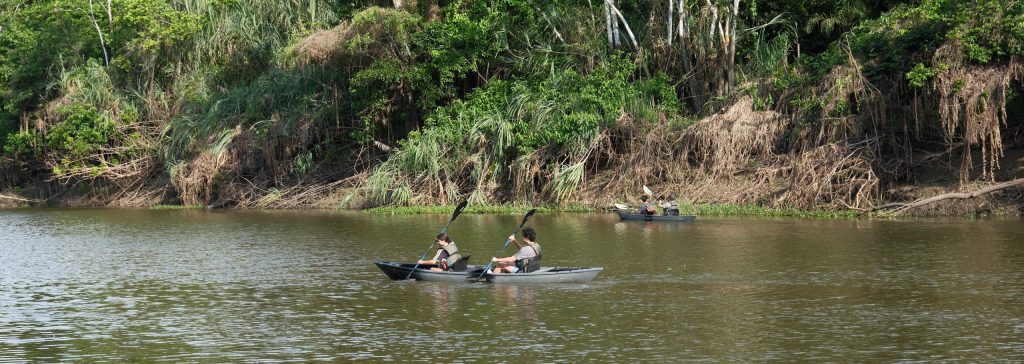
For those of us at Delfín, the journey into the Amazon has always begun with the river. An Amazon river cruise may carry us deep into the forest, but it is the water that first teaches us how to look.
From above, the forest can look almost impossible in its scale. Green stretching towards the horizon, divided by rivers that twist through it like veins. But once you are on the water, scale gives way to detail.
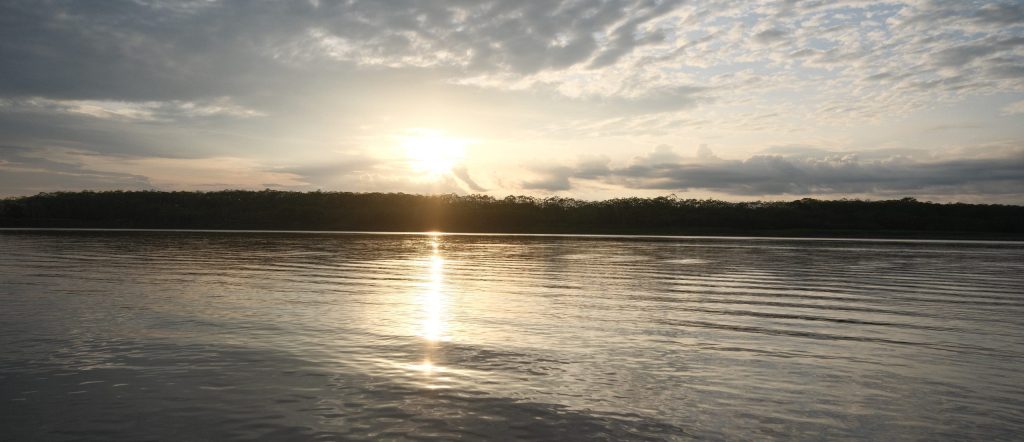
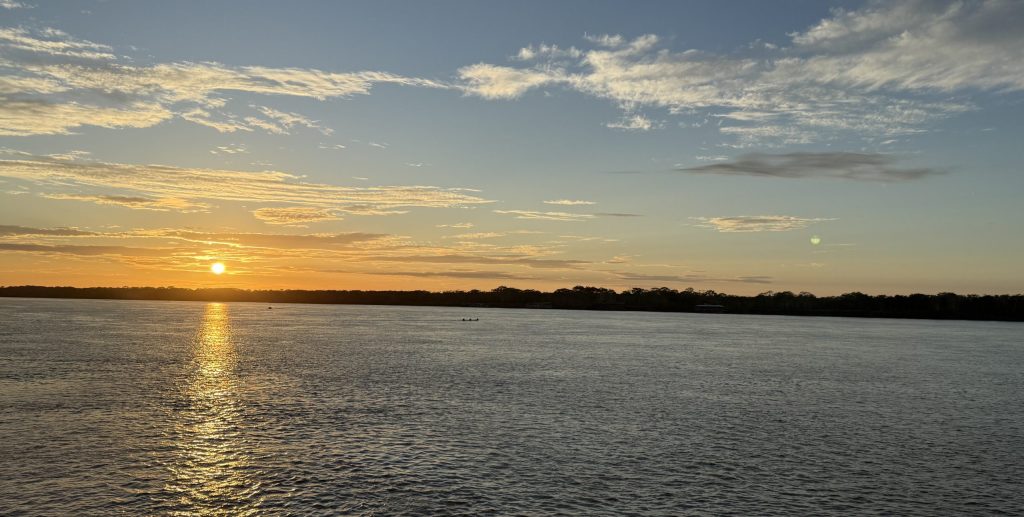
The river is never simply brown or blue. At dawn it can be bronze. Before a storm, silver. In the stillness of a narrow tributary, the reflections of trees can make it difficult to know where forest ends and water begins.
The air changes too. You feel the humidity on your skin. You hear insects before you see them. Rain arrives suddenly and with astonishing force, drumming against the canopy and the roof of the skiff.
Then it stops.
And the forest begins again.
This is one of the things we have learned after twenty years of navigating these waters. The Amazon is never the same place twice.
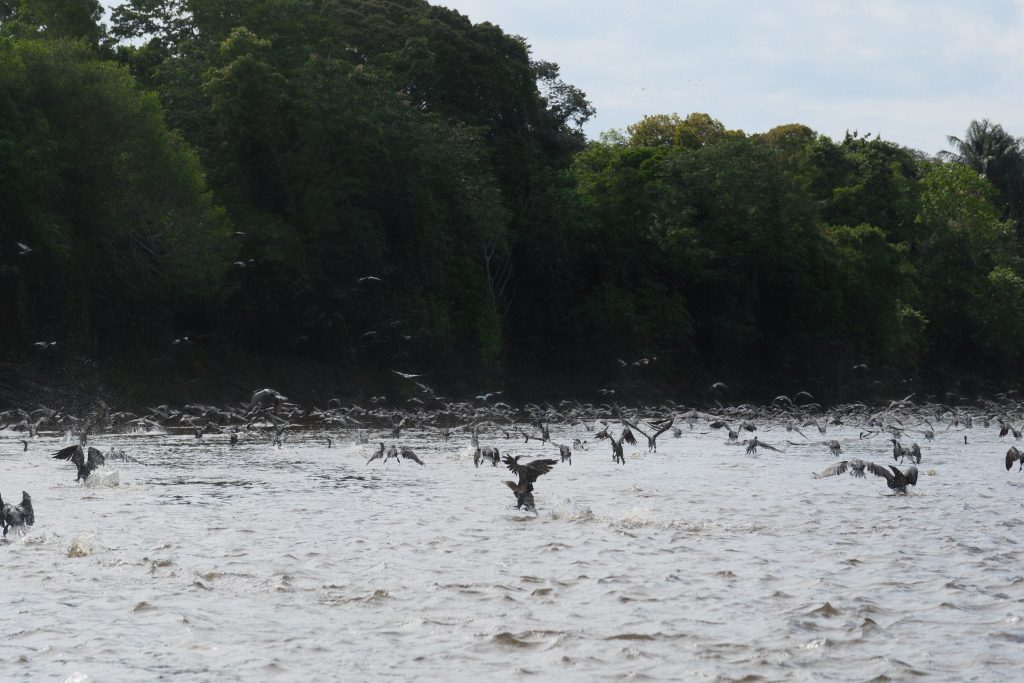
A channel open one season may become difficult to enter in another. Water rises into the forest and later retreats. Fish follow the floodwaters between the trees. Flowers appear. Fruit ripens. Birds arrive where yesterday there seemed to be none.
The forest has its own calendar.
To travel here is to enter that rhythm rather than impose our own.
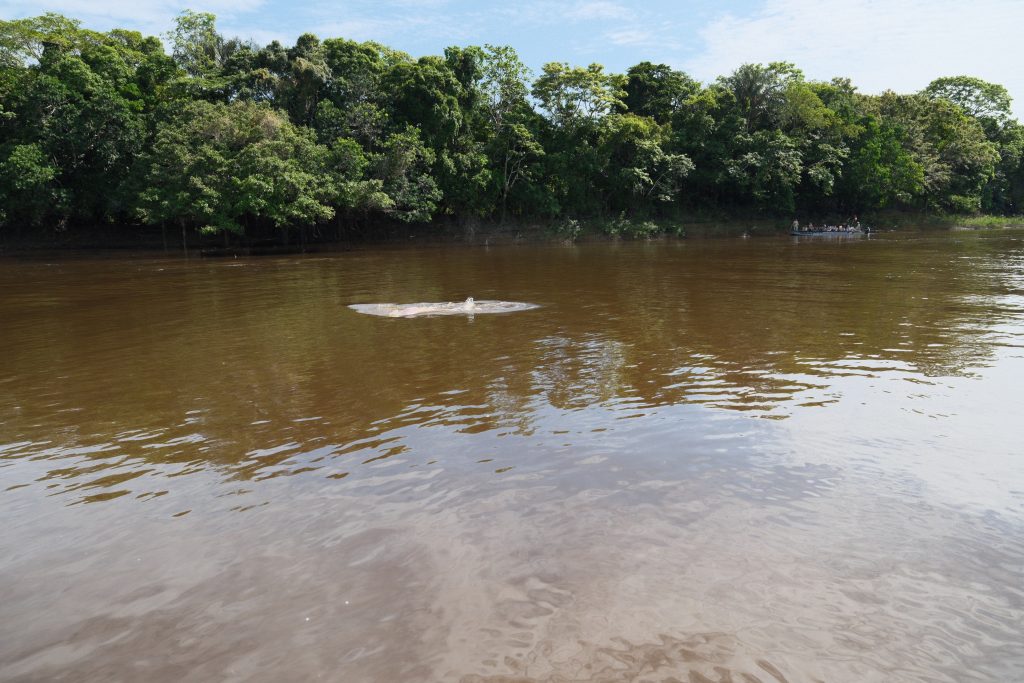
There may be mornings when pink river dolphins surface beside the skiff a sight many travellers associate with the Amazon rainforest in Peru. On another day, you may wait and see nothing at all. A branch that appears empty suddenly reveals a sloth. What looked like a leaf begins to move. Somewhere above you, a bird calls and a naturalist quietly raises a finger towards the canopy.
Look there.
At first, you see nothing.
Then you see it.
And after that, you wonder how you ever missed it.
This is one of the great pleasures of the Amazon. It teaches us how much exists beyond our immediate perception.
Learning to see
Our naturalists know this better than anyone.
Their knowledge is not simply a catalogue of species. It is a way of reading the forest.
A particular flower may suggest which bird could be nearby. A sound from high in the canopy can reveal what is happening long before an animal appears. The height and colour of the water tell their own stories. A fruiting tree may explain why monkeys have gathered in one part of the forest and disappeared from another.
What appears to the visitor as an overwhelming wall of green slowly becomes something else.
Relationships begin to emerge.
The longer we spend here, the more we understand that seeing is something we learn.
Curiosity may begin with names.
What bird is that?
Which tree is this?
Was that a monkey moving through the branches?
But eventually the questions change.
Why does this tree grow here?
Where do the fish go when the water falls?
How do communities know when the river is changing?
Which plants were used by grandparents and great grandparents?
Which stories have travelled down the river through generations?
And what is being lost?
The Scottish writer Nan Shepherd wrote in The Living Mountain that knowing another is endless, because what we seek to know grows with the knowing.
She was writing about mountains in Scotland, but anyone who has spent time in the Amazon may recognise the feeling.
The closer you look, the larger the place becomes.
Arriving as a guest
For centuries, outsiders wrote about the Amazon using the language of discovery.
But the Amazon was never waiting to be discovered.
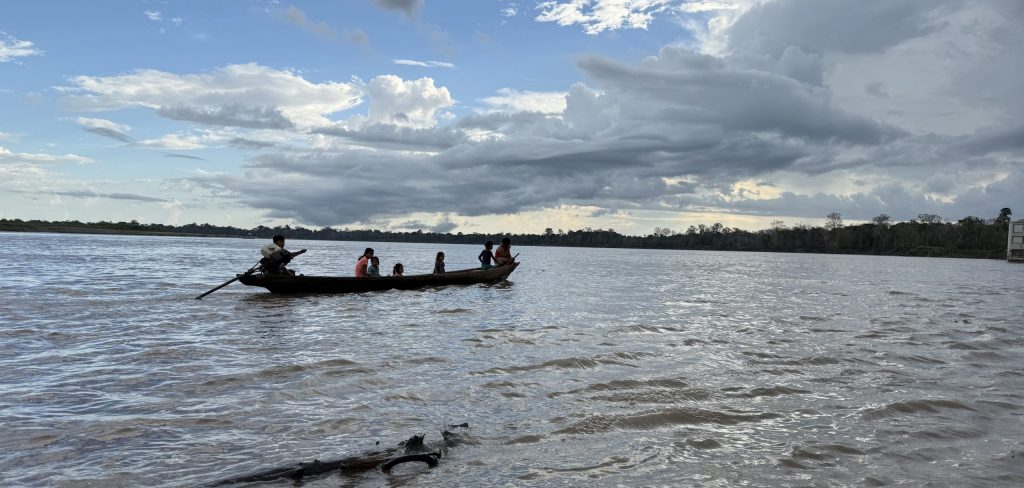
It has been lived in, travelled through, named, cultivated, remembered and understood by Indigenous peoples and river communities for generations beyond counting.
There are forms of knowledge here that do not live primarily in books.
They live in stories told at night and in the names of plants. People carry this knowledge by knowing where fish will be found at a particular moment in the season, understanding what the colour of the water is saying and remembering which trees once grew near a community and which ones have disappeared.
This changes the way we think about travel.
We are not arriving as discoverers.
We are arriving as guests.
And being a good guest requires something more than curiosity. It requires respect.
Respect can be as simple as asking before taking a photograph. Listening without immediately translating everything into our own terms. Understanding that a community is somebody’s home, not a backdrop for our journey.
It also means recognising that not everything has been placed there for us.
The Amazon does not perform on command.
The jaguar may not appear. The macaws may be somewhere else. Rain may change the afternoon completely.
There is freedom in accepting this.
Some of the moments we remember most have nothing to do with a checklist of sightings. They may be the silence after rain. The reflection of a child in the river. The sound of howler monkeys before sunrise. A conversation that continues longer than expected. The smell of the forest when the first drops begin to fall.
Travel becomes richer when we stop demanding that every moment deliver something.
Curiosity with consequence
There is another kind of curiosity that the Amazon awakens.
Once we begin to see how intricate these relationships are, we begin to ask what threatens them.
Who protects this forest?
When a plant disappears from an area where people once relied upon it, what follows?
How does a changing river affect a community?
What does tourism leave behind?
These questions matter to us.
Over the years, some of the work closest to Delfín has grown from listening to the communities around us. This has included helping to bring back native plants remembered by local communities species connected to food, medicine, craft and memory.
There is something deeply moving about planting a tree because somebody remembers it.
It reminds us that conservation is not only about protecting what remains.
Sometimes it is also about remembering what was there before.
The luxury of time
The Amazon also changes our relationship with time.
In cities, we tend to divide the day into increasingly small pieces. Meetings, messages, deadlines, appointments.
On the river, other forces take over.
Light.
Heat.
Rain.
Water.
The movement of animals.
Dawn is not simply an early hour. It is one of the great transitions of the forest.
Nightfall is another.
Trips to the Amazon become richer when we allow ourselves to move at the river’s pace.
The first time we travel along a tributary, we may see only green.
The next morning, we begin to distinguish palms from other trees.
Then we notice flowers.
Fruit.
Nests.
Movement.
We begin to hear individual sounds within what initially seemed like a single wall of noise.
This is why travelling slowly matters.
Not because slowness is fashionable, but because attention takes time.
There is a temptation in travel to keep adding: another excursion, a new destination, one more photograph and something else to say we have done.
But perhaps one of travel’s rarest privileges today, even on a luxury Amazon river cruise, is the permission to do less.
We might sit in a skiff and listen.
Perhaps we watch the light change on the river.
Sometimes, we simply wait.
In doing less, we allow a place to remain partly mysterious.
Not every beautiful moment needs to become a photograph. Not every experience needs to be shared immediately. Some things are worth keeping long enough to understand what they meant.
What we take home
We often say that travel transforms us.
Perhaps it does.
But transformation is a large word for something that often happens very quietly.
Most of us return to the same homes, the same responsibilities, the same overflowing inboxes.
What changes may be smaller.
Water begins to look different.
A familiar bird call suddenly stands out.
Gradually, the forest reveals itself not as an empty wilderness, but as a network of lives, histories and relationships.
With that understanding comes a greater awareness of how much remains unknown.
Brazilian writer and journalist Eliane Brum has argued that the Amazon should be understood not as a distant green margin of the world, but as its centre.
It is a powerful reversal.
For so long, maps have encouraged us to imagine some places as central and others as remote. Travel has the ability to rearrange those maps.
Not only the geographical ones.
The ones inside us too.
The maps that shape whose knowledge matters, what we consider valuable, how we define progress, how we understand nature and where we believe the centre of the world lies.
Perhaps this is why curiosity remains one of the most important reasons to travel.
Not the curiosity of collecting places, but the deeper curiosity that asks us to reconsider what we thought we knew.
After twenty years in the Peruvian Amazon, including journeys through the Pacaya Samiria Reserve, we still feel this.
The river continues to surprise us.
The forest continues to reveal things we had not noticed before.
The people we work alongside continue to teach us.
And the more we learn, the more apparent it becomes that a single journey can reveal only part of the Amazon. Full understanding may always remain beyond reach.
That is part of its pull.
We arrive wondering what we will see.
We leave thinking about what we did not see, what we did not ask, what we have only begun to understand.
And somewhere between those two moments, travel has done what it does best.
It has made the world larger.
July 24, 2026