


Stingless Bees of the Peruvian Amazon: Inside Bee Queen Coin
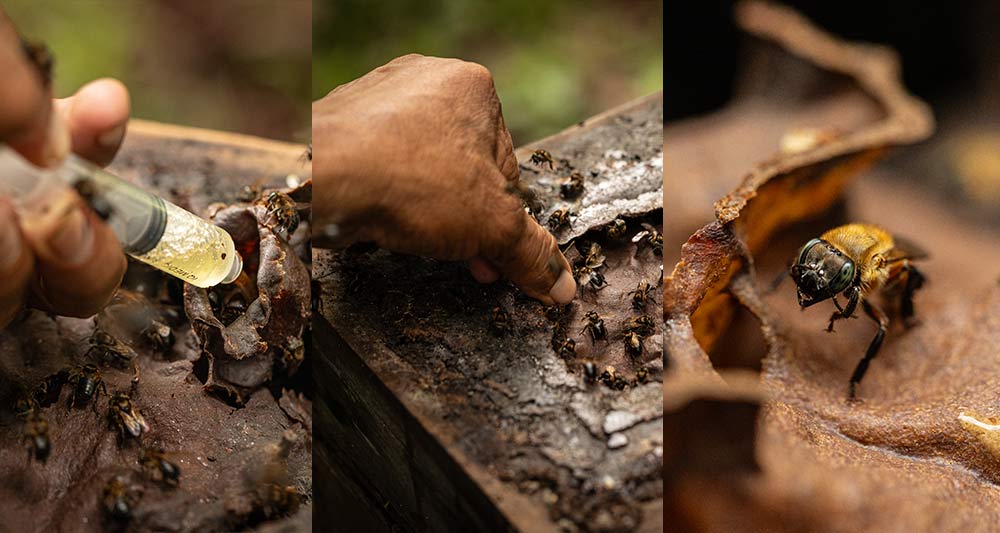
On the road between Iquitos and Nauta, there is a house where the bees do not sting. They climb your finger, taste the salt of you, and move on. The boxes that hold them hum at a pitch closer to breath than to alarm. Twenty-nine species live here. Most of the world has never heard of any of them.
These are the stingless bees of the Peruvian Amazon, the much older cousins of the European honeybee everyone learned about in school. Peru holds around one hundred and seventy-five species. The cooperative that looks after these particular hives, Bee Queen Coin, turns six on the twentieth of May, which happens to be both Peru’s National Bee Day and the United Nations’ World Bee Day. The date was not planned. It chose itself.
Adriano Meza, the founder, never trained in biology or medicine. He learned everything here, from the bees themselves and from the families of Loreto who became his teachers. He began in 2019 with two hives. Today there are more than fifteen hundred, in over sixty communities and with five hundred families. In six years, those hives have pollinated an estimated twelve billion flowers.
Twelve billion is impossible to picture. So instead: the unbroken green you see from a Delfín skiff at dawn, every fruiting tree, every flowering vine of the riverbank, is held up by insects no traveller will see. A small share of those insects, in this part of the world, are stingless.

Stingless Bees of the Peruvian Amazon: What Makes Them Different
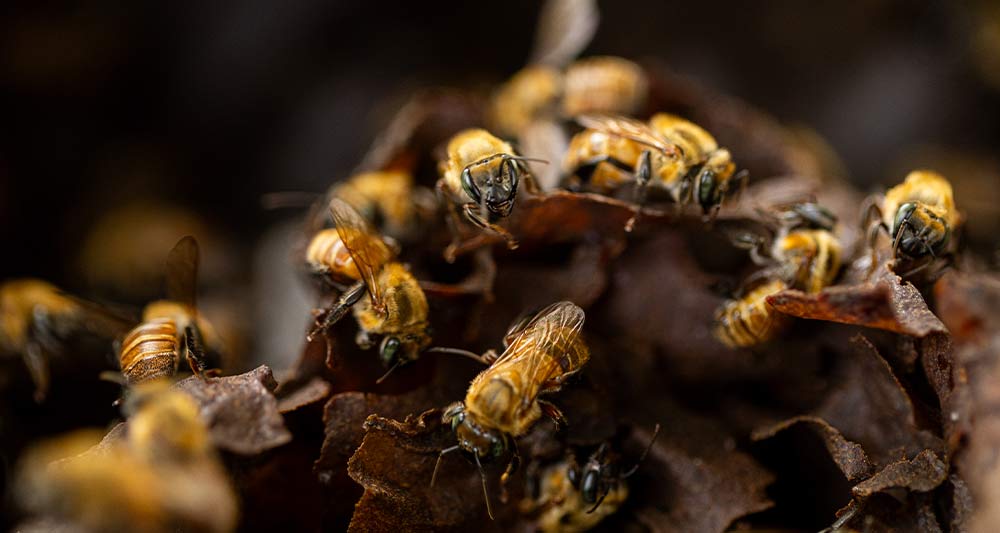
The Meliponini are a tribe of more than six hundred species, divided into meliponas, tetragonas, trigonas, paratrigonas, oxitrigonas, and others. Melipona eburnea, for example, is one of the species Adriano works with on the Iquitos–Nauta road.
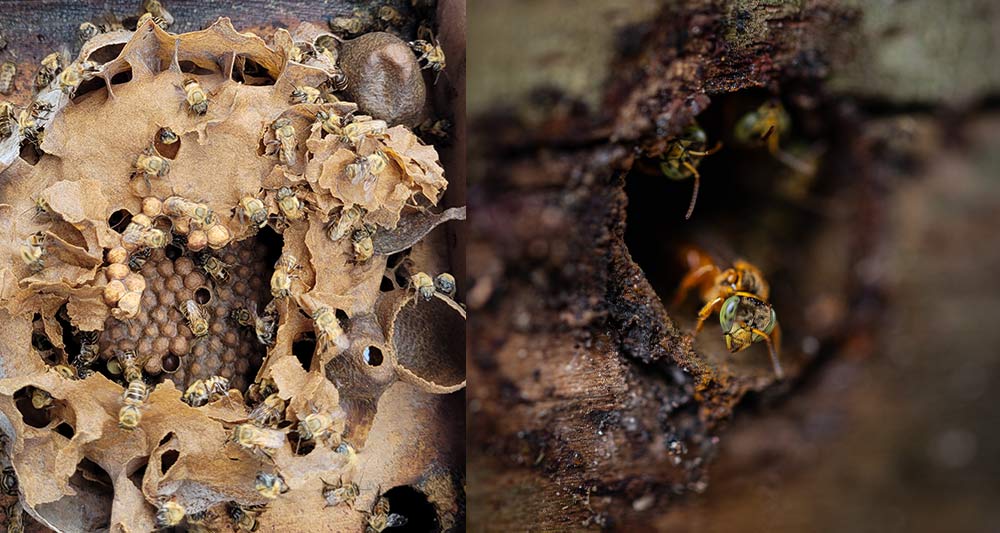
They have no sting. Their defence is the mandible: a bite at the soft places under the eyes, inside the nose, behind the ears. It registers as a small surprise and then it is gone.
The colonies are far smaller too. A European hive holds roughly fifty thousand bees. A melipona nest holds around two thousand. They store their honey in dark wax pots five to seven times larger than the bee itself. The hexagonal cells of European hives are reserved here for the brood, not the honey. The wax is dark because they mix it with propolis and tree resins, so the honey carries the flavour of the forest the bees visited. Some pots taste floral. Others come closer to a young wine, or to vinegar, than to anything you would call dessert.
This is honey as medicine, not honey as breakfast.
Why “rescue” is the right verb
Adriano uses the word rescatar often. Fifteen hundred hives rescued. The verb is worth taking literally.
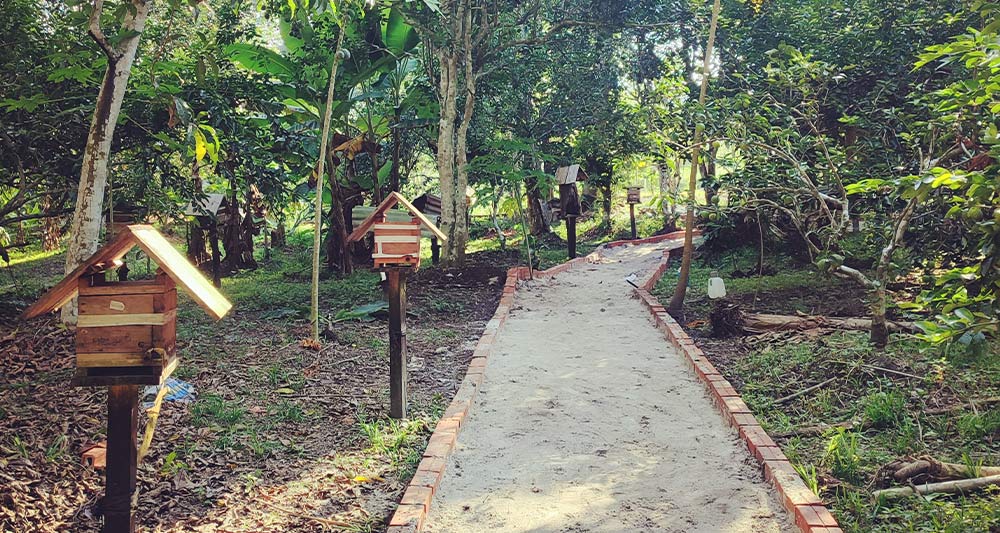
For generations, when people in the forest found a wild nest, they broke it open, took the honey, and walked away. Nine out of ten nests harvested that way died. The honey was traded; the bees were not. And so, when Bee Queen Coin first began buying honey to sweeten its juices, demand alone was about to kill more bees than it saved.
The fix was unromantic. Put a price on the colony rather than on the honey. Teach families to find a wild nest inside a fallen log and move it into a hive box. Pay them properly for the work. Suddenly the bees were worth more alive than dead. The shift took time, and it is still taking time. Now, when Adriano walks into a community, the people who come to meet him first are almost always the children.
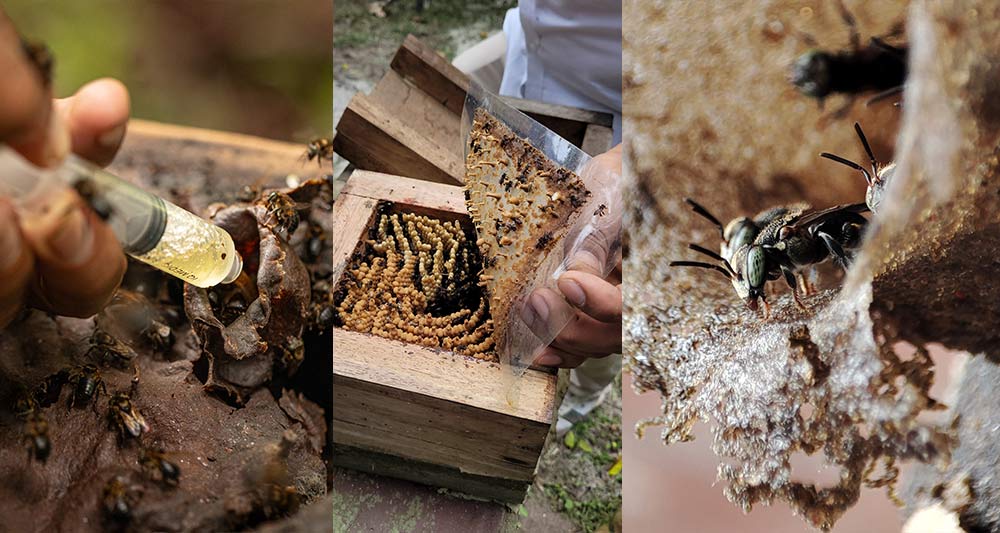
The children ask the question that changed the whole project. They look at the boxes and say: I am going to have a new pet. How do I feed her? They do not ask when she will produce. They ask how to keep her alive.
So the project began planting seeds with them. Camu camu, aguaje, papaya, flowering trees of the region. The bees feed themselves. The forest grows back, slowly, around the houses.
The last stop before the flight

Most Delfín guests meet Adriano on their final morning, on the road back to the airport. He is the last Peruvian voice many travellers hear before boarding the plane home. He pours a small spoon of honey into your palm. He explains, without rushing, the forest you have just spent a week inside.
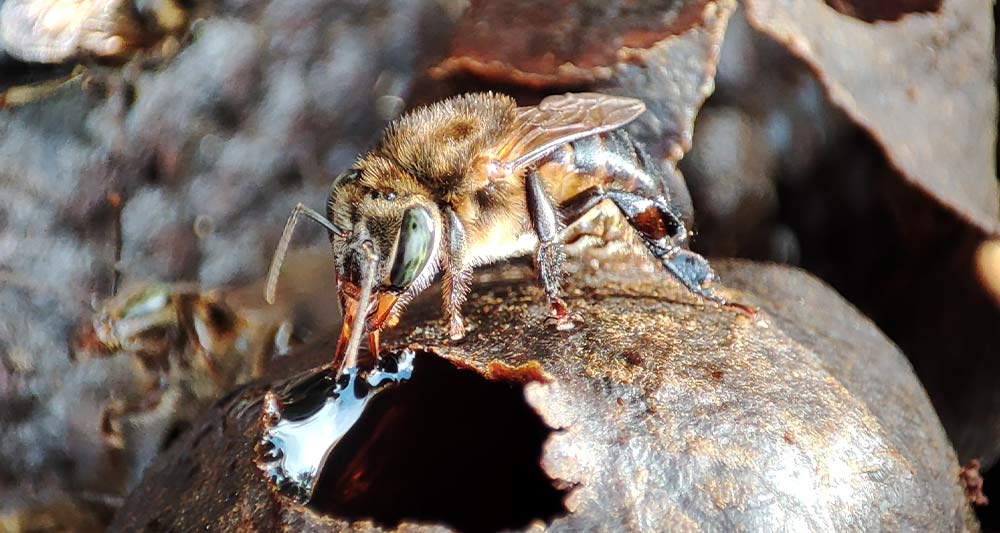
In October 2025, the municipalities of Satipo and Nauta declared the melipona a subject of rights, the first insect anywhere to receive that protection on paper. Adriano is cautious about it. A law that is not enforced, he says, is a law nobody respects. The work itself, family by family, log by log, will outlast any declaration.
Adriano has a line about the bees that is hard to forget. A stingless bee lives around sixty days. She leaves the nest every morning, visits close to a thousand flowers, brings back nectar and pollen, and dies long before any of the trees she pollinated bear fruit. She works for generations she will not meet. Then, he says, she lets those generations judge her by what she leaves behind.
It is a useful idea to carry onto a flight.
Credits:
Photography courtesy of Bee Queen Coin
May 18, 2026